ZEISS 440762-9904 Plan Apochromat Oil Dic Microscope 63X/1.4 /0.17 Objective
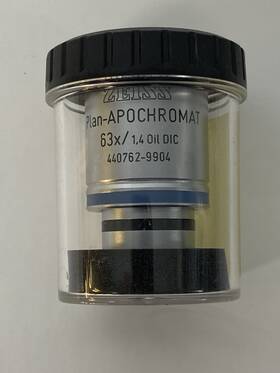
( Brand: Zeiss ), ( Manufacturer Part Number: 440762-9904 ), ( Model: 440762-9904 63X/1.4 /0.17 ), ( Part Type: Oil ), ( Country Of Origin: Germany ), ( Intended Use/discipline: Biological Laboratory )
Review ZEISS Plan apochromat 63x/1.4 Oil Dic /0.17 Microscope Objective
The **Zeiss Plan-Apochromat 63x/1.4 Oil DIC (Differential Interference Contrast) Objective (Part No. 440762-9904)** is a high-performance, precision-engineered optical component designed for advanced fluorescence and brightfield microscopy, delivering unparalleled resolution, contrast, and imaging fidelity. Part of Zeiss s renowned Plan-Apochromat series, this objective combines cutting-edge apochromatic correction with differential interference contrast (DIC) capabilities, making it an indispensable tool for researchers and biologists studying fine cellular structures, subcellular components, and dynamic biological processes. With a numerical aperture (NA) of 1.4, this lens maximizes light-gathering power, enabling the visualization of ultra-fine details such as organelle morphology, cytoskeletal arrangements, and thin tissue sections with exceptional clarity and minimal spherical and chromatic aberrations. The oil immersion design enhances resolution by reducing light scattering, while the DIC system enhances contrast by converting phase shifts in transparent specimens into visible interference patterns, revealing structural nuances that would otherwise remain obscured in conventional brightfield imaging.
Constructed with Zeiss s proprietary glass formulations and multi-layer coatings, the Plan-Apochromat 63x/0.17 objective ensures near-perfect correction across a broad spectrum of wavelengths, from ultraviolet to near-infrared, making it compatible with a wide range of fluorescence markers and staining techniques. The 0.17 working distance accommodates thick coverslips (typically 1.5 mm) and allows for precise focusing on live cells or fixed specimens without risking damage to delicate samples. The robust, durable design incorporates a front-mounted correction collar, enabling fine adjustments to optimize focus and aberration correction when switching between different immersion oils or coverslip thicknesses. This objective is particularly well-suited for applications in cell biology, neuroimaging, developmental biology, and materials science, where high-resolution, high-contrast imaging is critical for accurate data acquisition and analysis.
Beyond its technical specifications, the Zeiss Plan-Apochromat 63x/1.4 Oil DIC objective embodies the brand s commitment to innovation and reliability, offering a seamless integration with Zeiss s Axio and other high-end microscope platforms. Its compatibility with motorized focus systems, automated stage controls, and advanced imaging software further enhances its utility in high-throughput and quantitative microscopy workflows. Whether used in fluorescence imaging to track protein localization or in DIC mode to study tissue architecture, this objective delivers a level of optical performance that sets new standards for microscopic exploration, empowering researchers to uncover the intricate details of life at the cellular and subcellular levels with confidence and precision.
The **Zeiss Plan-Apochromat 63x/1.4 Oil DIC (Differential Interference Contrast) objective (part number 440762-9904)** is a high-end, high-numerical-aperture (NA) objective designed for advanced fluorescence and brightfield microscopy. Below is a detailed analysis of its pros and cons, followed by a conclusion and recommendation.
---
### **Pros**
1. **Exceptional Resolution and Clarity**
The 1.4 NA design provides superior resolution, allowing for the visualization of fine structural details at the sub-micron level. This is critical for high-magnification imaging, such as cellular ultrastructure, organelle studies, and detailed fluorescence imaging.
2. **Corrected for Spherical and Chromatic Aberrations**
As an apochromatic objective, it minimizes chromatic aberrations across a broad spectrum (typically UV to near-IR), ensuring consistent image quality regardless of the wavelength used. This is particularly valuable for multi-channel fluorescence imaging where different fluorophores emit across varying wavelengths.
3. **Plan-Apochromat Design**
The "Plan" designation indicates a flat field of view, reducing curvature of field errors. This is advantageous for imaging large samples or when using digital cameras with wide sensors, as it ensures a uniform focus plane across the entire field of view.
4. **Differential Interference Contrast (DIC) Compatibility**
The objective is optimized for DIC, a technique that enhances contrast in transparent or unstained samples by converting phase shifts into brightness variations. This is useful for live-cell imaging, developmental biology, and samples with low inherent contrast.
5. **High Numerical Aperture (NA 1.4)**
The high NA allows for the collection of more light and improved axial resolution, which is essential for thick samples or when imaging deep within tissues.
6. **Durable and High-Quality Construction**
Zeiss objectives are known for their precision engineering, durability, and long-term stability. The 63x/1.4 is built to withstand rigorous use in research environments.
7. **Compatibility with Advanced Microscopy Techniques**
The objective works well with confocal microscopy, super-resolution techniques (e.g., STED, SIM), and other high-end imaging modalities due to its low aberration profile.
8. **Long Working Distance Relative to NA**
While the working distance is short (typically 0.17 mm), it is relatively longer than what one might expect for a 1.4 NA objective, reducing the risk of damaging samples during imaging.
---
### **Cons**
1. **High Cost**
The Zeiss Plan-Apochromat 63x/1.4 is one of the most expensive objectives available. The price can range from **$3,000 to $5,000 **, depending on the microscope system and additional features (e.g., immersion oil compatibility, DIC). This makes it a significant investment, especially for laboratories with limited budgets.
2. **Short Working Distance**
The working distance is very short ( 0.17 mm), which can be challenging for certain sample preparations. Thick coverslips (e.g., #1.5 vs. #1) or samples with uneven surfaces may not be compatible without additional adjustments (e.g., grinding coverslips or using immersion oil carefully).
3. **Requires High-Quality Immersion Oil**
The objective demands precise refractive index matching with immersion oil (typically n 1.515). Using low-quality or mismatched oil can introduce aberrations and reduce image quality. This adds to the ongoing cost of maintenance.
4. **Sensitivity to Sample Preparation**
Due to the high NA and short working distance, the objective is sensitive to sample thickness, coverslip quality, and immersion oil application. Improper preparation can lead to aberrations or damage to the objective.
5. **Limited Field of View**
High-magnification objectives like this one have a narrow field of view, which may require multiple images to capture larger samples. This can be time-consuming for large-scale imaging.
6. **Potential for Damage**
The high NA and delicate design make the objective susceptible to damage from scratches, immersion oil contamination, or improper handling. It requires careful storage and cleaning procedures.
7. **Not Ideal for Brightfield Without DIC**
While the objective is excellent for DIC, it may not perform as well in standard brightfield mode without contrast enhancement techniques. For general brightfield work, lower NA objectives (e.g., 40x/0.95) might be more versatile.
8. **Compatibility Issues with Some Microscopes**
The objective may not fit all microscope models, particularly older or non-Zeiss systems. Compatibility with the condenser, illumination, and camera system must be verified to avoid issues.
---
### **Conclusion**
The **Zeiss Plan-Apochromat 63x/1.4 Oil DIC** is one of the best objectives available for high-resolution fluorescence and DIC microscopy. Its superior correction, high NA, and compatibility with advanced imaging techniques make it indispensable for research requiring fine structural details. However, its high cost, short working distance, and sensitivity to sample preparation can be significant drawbacks, particularly for laboratories with limited resources or those working with thick or irregular samples.
This objective is best suited for:- **Advanced fluorescence imaging** (e.g., confocal, super-resolution).
- **DIC microscopy** for live-cell or unstained samples.
- **Research requiring maximum resolution** (e.g., neuroscience, cell biology, developmental biology).
For users who do not require such high resolution or have budget constraints, alternatives like **Zeiss Plan-Apochromat 63x/1.4 Oil (non-DIC)** or **Nikon Plan Apo VC 60x/1.4 Oil** (which may offer slightly better working distance) could be considered. Additionally, lower-magnification objectives (e.g., 40x or 100x with lower NA) may suffice for less demanding applications.
### **Recommendation**
**Buy this objective if:**- You are working in a field that demands the highest possible resolution (e.g., detailed fluorescence imaging, super-resolution microscopy).
- Your budget allows for the investment, and you can justify the cost based on your research needs.
- Your samples are thin, properly prepared, and compatible with high-NA imaging (e.g., cells on glass slides with #1.5 coverslips).
- You require DIC for contrast enhancement in transparent samples.
**Avoid or consider alternatives if:**- Your budget is limited, and lower-magnification objectives (e.g., 40x/1.3 or 60x/1.4) would suffice.
- Your samples are thick or irregular, making high-NA imaging difficult.
- You do not frequently use DIC and could benefit from a more versatile objective (e.g., a Plan-Apochromat without DIC).
- You are working with a microscope system that may not fully support the objective s performance.
For most **high-end research laboratories** focused on fluorescence or DIC microscopy, this objective is a worthwhile investment. For **teaching labs, clinical settings, or budget-conscious research**, alternatives may be more practical. Always verify compatibility with your microscope system and sample types before purchasing.
Details:
Priced accordingly. This may need to be cleaned. I'm not a microscope dealer or expert. I looked at the lens with an eyepiece and did not see any lamination, cracks or scratches on.
Includes the following microscope objective: 1 - ZEISS PLAN-APOCHROMAT 63X/1.4 OIL DIC /0.17, This does have a dent on end that is clearly shown in last picture.
part #: 4407629904 prices
- $650.00-$1995.00
specifications microscopepartzo:
- brand: Zeiss
- mpn: 440762-9904
- model: 440762-9904 63x/1.4 /0.17
- part type: Oil
- country of origin: Germany
- intended use/discipline: Biological Laboratory
seller microscopepartzo:
- rating: 100.0%
- city: Mechanicsville, Virginia
- # reviews: 2708
shipping microscopepartzo:
- service: FedEx Ground / FedEx Home Delivery
- cost: $34.96
- transit: 4-7 Days
- carrier: FedEx
- class: Standard
- type: Calculated
returns microscopepartzo:
- policy: No Returns
offer microscopepartzo:
- options: Ship-to-home
- started: May 29, 2026
- quantity: 1
- sold: 0
- availability: In Stock
general microscopepartzo:
- condition: Used
- Medical/Lab Equipment Attachments Accessories > Microscope Parts Accessories > Other Microscope Parts Accessories
payments microscopepartzo:
- wallet: Google-pay
- credit card: Diners-club
- other
Zeiss 440762-9904 Is Similar To:
- 0.11-0.23 Zeiss Objective Plan-neofluar 63 160 0.90 (23.3% similar) Comes as shown. Zeiss plan nodular acquired from government surplus. No manuals,no standard power cords, accessories, software etc are included unless pictured and noted in the. All equipment is sold as is as you know with most government agencies, when a new grant comes in, they have to justify the...(January 30th, 2015)
- Carl Planapo Good Objective 4x 0.14 Rare Very Microscope Condition Zeiss (41.6% similar) 2MM thread sizes RMS royal microscope society standard. Made in west germany. 14 numerical aperture microscope objective, part number. This objective designed for bright field and dark field applications for 160MM microscope tube. This is a rare Carl Zeiss Plano 4X. This Plano 4x microscope ...(February 1st, 2015)
- Zeiss Opmi Microscope 10x F170 0-180 Eyepieces Binocular Surgical (32.6% similar) Carl Zeiss binocular F170 with 10X eyepieces...(December 31st, 2014)
- Mag Stereo Oculars 2480 Zeiss Knob Si 0.63-6.3 10 P16x 12.5 Microscope Jena Aus (34.8% similar) It has the numbers 2480 Si 10 on the bottom. It was made in the german democratic republic you are buying on one rare vintage type 1970 'S AIs Jean stereo microscope with a pair of P16X 12. See photos overall good clean condition, only minor wear, and clean lenses no light source included. 5 ...(January 15th, 2015)
- 000000-1108-667 Carl Zeiss Microscope Lamp Power Supply Used Working (26.4% similar) For lift gate service and 45. The bureaus of us. Pictured test equipment is not included or available for sale. Specifications part no: 667 sale details item condition: used working, 90 day warranty estimated packed shipping dimensions: l x W14 X14 7 lbs. Only items pictured are included: if a part ...(April 26th, 2018)
- 000000-1170-901 Zeiss Microscope Dic Slider Ec Epn And Hr Objective (36.4% similar) 90 hr with plastic cover to protect slider. Unconditional money back guarantee item code: A338 Zeiss microscope dic slider for ec Pen 50X. Condition: new. Zeiss microscope dic slider for ec Pen 50X 100X. 90 hr objectives: Zeiss dic slider item number: 901 compatible with these prisms: ec Pen 50X...(June 8th, 2018)
- 000000-1170-902 Zeiss Microscope Dic Slider Ec Epn (30.2% similar) Unconditional money back guarantee item code: A335 Zeiss microscope dic slider ec Pen 100X condition: new. Zeiss microscope dic slider for ec Pen 100X: item number: 902 compatible with these objectives prisms: and HX LED 50X fluorescence microscopes the solution to your microscopy needs. 80 HX LED ...(June 15th, 2018)
- 000000-1374-896 Carl Zeiss Vg Green Filter Microscope (34.1% similar) New with no signs of normal wear and tear. Carl Zeiss VG 9 green FILTER32X2MM item number: 896 filter, 32X2MM for contrast enhancement phase and b w image recording unused - with box excellent condition. This item is unused and untested...(March 31st, 2018)
- 0428-273 Carl Zeiss Fluorescent Epi Illuminator Axiostar Fl Reflected Microscope (33.3% similar) Pei illumination attachment for Zeiss Acosta microscope excellent shape with all components polarizing filter included. Both sliders...(May 8th, 2018)
- 05-9902 Microscope Slider Axiomat 47 Zeiss Magazine Dic Phase 57 Adjustable (25.2% similar) USPS or ups ground. Save packaging for carrier claim. Standard shipping prices are only good for the lower 48 states. An image to Zeiss axiom at adjustable microscope magazine dic phase slider P/N this unit appears to be fully functional knobs spin freely lens is in good condition scratches are ...(February 3rd, 2015)
- Zeiss 1.25oil 05 Objective F100 19 46 (38.9% similar) Appears clear. All equipment is sold as is. No manuals,no standard power cords, accessories, software etc are included unless pictured and noted in the. Comes as shown. Shipping buyer to pay shipping in the us...(December 31st, 2014)
