ZEISS 453607 Microscope Polarizer Analyzer Slider Vertical Illumination
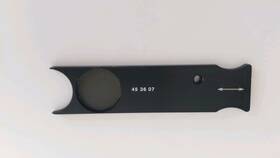
( Brand: Zeiss ), ( Manufacturer Part Number: 453607 ), ( Part Type: Analyzer )
Review ZEISS Microscope Polarizer Analyzer Slider Of Vertical Illumination
The **Zeiss 453607 Polarizer-Analyzer Slider for Vertical Illumination** is a precision-engineered optical accessory designed to enhance the functionality of polarized light microscopy, catering to researchers, biologists, and materials scientists who require superior control over light polarization in their observations. This high-quality component integrates seamlessly into Zeiss microscope systems, particularly those equipped with vertical (transmitted) illumination, enabling users to manipulate the orientation and intensity of polarized light with exceptional accuracy. Crafted with meticulous attention to optical clarity, the slider houses a high-precision polarizer and analyzer, both of which are optimized to minimize light scattering and maximize contrast in birefringent samples, such as mineralogical specimens, liquid crystals, or biological tissues exhibiting anisotropic properties. The robust mechanical design ensures smooth, repeatable adjustments, allowing researchers to fine-tune the angle of polarization with minimal effort, whether for routine analysis or complex experimental setups. Ideal for applications in crystallography, materials science, and cell biology, this slider enhances the diagnostic capabilities of polarized light microscopy by providing a versatile tool for studying optical activity, stress patterns, and molecular alignment within samples. Its compatibility with Zeiss s advanced illumination systems further underscores its role as an indispensable component for laboratories seeking to push the boundaries of optical resolution and analytical precision.
The Zeiss 453607 Microscope Polarizer/Analyzer Slider for Vertical Illumination is a specialized accessory designed to enhance polarized light microscopy. Below is a detailed breakdown of its pros and cons, followed by a conclusion and recommendation.
---
### **Pros**
1. **Enhanced Polarized Light Imaging**
The slider integrates both a polarizer and an analyzer, which are essential for observing birefringent materials (e.g., crystals, fibers, and mineral samples). This setup allows for the visualization of stress patterns, crystal structures, and optical properties that would otherwise be invisible under standard illumination.
2. **Compatibility with Zeiss Microscopes**
As a Zeiss product, this slider is designed to fit seamlessly with Zeiss microscopes, ensuring optimal alignment, stability, and functionality. It is particularly useful for models that support vertical illumination, such as the Axioskop, Axio Imager, or other research-grade microscopes.
3. **Adjustable and Precise Control**
The slider allows for fine adjustments of the polarizer and analyzer angles, which is critical for fine-tuning contrast and clarity in polarized light microscopy. This precision is invaluable for applications in materials science, geology, and biology.
4. **Durability and Build Quality**
Zeiss components are known for their robust construction and longevity. The slider is likely made from high-quality materials that can withstand frequent use without significant wear, making it a long-term investment.
5. **Versatility in Research and Industrial Applications**
Polarized light microscopy is used in a wide range of fields, including:- **Materials Science:** Analyzing fiber orientation, polymer structures, and composite materials.
- **Geology:** Studying mineralogy and identifying birefringent minerals.
- **Biology:** Observing muscle fibers, collagen, and other structured tissues.
- **Metallurgy:** Investigating grain boundaries and stress patterns in metals.
The slider is thus a versatile tool for researchers and industrial professionals.
6. **Ease of Integration**
Since it is designed for vertical illumination, it can be easily added to existing setups without requiring major modifications to the microscope. This makes it a practical upgrade for labs that already use polarized light techniques.
7. **High Optical Clarity**
Zeiss optics are renowned for their minimal distortion and high light transmission, ensuring that images remain sharp and free from artifacts even when using polarized light.
---
### **Cons**
1. **High Cost**
Zeiss equipment is premium-priced, and this slider is no exception. For labs or individuals with limited budgets, the cost may be prohibitive, especially if other essential components are also required (e.g., a condenser for polarized light).
2. **Limited Compatibility Outside Zeiss Systems**
While the slider is designed for Zeiss microscopes, it may not be fully compatible with non-Zeiss systems without additional adapters or modifications. This could add to the overall cost and complexity of setup.
3. **Learning Curve for Polarized Light Techniques**
Mastering polarized light microscopy requires familiarity with the principles of birefringence, extinction positions, and the proper alignment of polarizers and analyzers. Users may need training or practice to achieve optimal results, which could slow down initial adoption.
4. **Maintenance and Calibration**
Like all optical components, the polarizer and analyzer may require periodic cleaning or recalibration to maintain performance. Dust, scratches, or misalignment can degrade image quality, and these issues may not be easily addressable without professional assistance.
5. **Space and Setup Requirements**
Polarized light microscopy often requires additional components, such as a rotating stage or a specialized condenser (e.g., a Bertrand lens). These may not be included with the slider, necessitating further investment to create a fully functional setup.
6. **Potential for Overkill in Basic Applications**
If the user s work does not frequently involve polarized light techniques, the slider may remain underutilized. In such cases, the cost may not justify the purchase, and a more general-purpose illumination system could suffice.
7. **Dependence on Microscope Configuration**
The effectiveness of the slider depends heavily on the microscope s overall configuration. For example, if the microscope lacks a high-quality condenser or a precise stage, the images produced may still be suboptimal despite using the slider.
---
### **Conclusion**
The Zeiss 453607 Polarizer/Analyzer Slider for Vertical Illumination is a high-quality, specialized tool that significantly enhances the capabilities of polarized light microscopy. Its strengths lie in its precision, compatibility with Zeiss systems, and the breadth of applications it supports. However, its high cost, potential compatibility issues with non-Zeiss microscopes, and the need for additional components or training may pose challenges for some users.
The slider is best suited for:- Research labs or industrial settings where polarized light microscopy is a routine requirement.
- Users who already own a Zeiss microscope and need to upgrade their illumination capabilities.
- Applications in materials science, geology, or biology where birefringence analysis is critical.
For users with limited budgets or those whose work does not heavily rely on polarized light techniques, the investment may not be justified. In such cases, alternatives like third-party polarizers or more general illumination systems could be considered.
---
### **Recommendation**
**Purchase the Zeiss 453607 slider if:**- You are working in a field (e.g., materials science, geology, or advanced biology) where polarized light microscopy is essential.
- You already own a compatible Zeiss microscope and require a reliable, high-performance polarizer/analyzer setup.
- Your budget allows for the investment, and you can justify the cost based on the long-term value and precision it provides.
**Consider alternatives or delay purchase if:**- Your primary applications do not frequently use polarized light techniques.
- You are working with a non-Zeiss microscope and are unsure about compatibility or the need for additional adapters.
- Your budget is constrained, and you can achieve similar results with lower-cost third-party options or by modifying your existing setup.
For those who decide to proceed, pairing the slider with a high-quality condenser (e.g., a Zeiss condenser for polarized light) and investing in training or documentation on polarized light microscopy techniques will maximize its effectiveness.
Details:
Zeiss Microscope Polarizer Analyzer Slider of Vertical illumination 453607.
part #: 453607 prices
- $75.00-$395.00
specifications microscopepartzo:
- brand: Zeiss
- mpn: 453607
- part type: Analyzer
offer microscopepartzo:
- sold: 0
- started: February 4, 2026
- availability: In Stock
- quantity: 1
- options: Ship-to-home
seller microscopepartzo:
- # reviews: 1796
- rating: 100.0%
- city: Alhambra, California
returns microscopepartzo:
- paid by: Buyer
- time: 30 Days
- policy: Returns Accepted
- method: Money back
general microscopepartzo:
- Medical/Lab Equipment Attachments Accessories > Microscope Parts Accessories > Other Microscope Parts Accessories
- condition: Used
shipping microscopepartzo:
- type: Fixed
- service: Standard
- cost: $0.00
- transit: 3-8 Days
- class: Standard
payments microscopepartzo:
- wallet: Apple-pay
- credit card: Diners-club
- other
Zeiss 453607 Is Similar To:
- Carl Planapo Good Objective 4x 0.14 Rare Very Microscope Condition Zeiss (34% similar) 2MM thread sizes RMS royal microscope society standard. Made in west Germany. 14 numerical aperture microscope objective, part number. This objective designed for bright field and dark field applications for 160MM microscope tube. This is a rare Carl Zeiss Plano 4X. This Plano 4x microscope ...(February 1st, 2015)
- Zeiss Opmi Microscope 10x F170 0-180 Eyepieces Binocular Surgical (41.7% similar) Carl Zeiss binocular F170 with 10X eyepieces...(December 31st, 2014)
- Mag Stereo Oculars 2480 Zeiss Knob Si 0.63-6.3 10 P16x 12.5 Microscope Jena Aus (31.4% similar) It has the numbers 2480 Si 10 on the bottom. It was made in the German democratic republic you are buying on one rare vintage type 1970 'S AIs Jean stereo microscope with a pair of P16X 12. See photos overall good clean condition, only minor wear, and clean lenses no light source included. 5 ...(January 15th, 2015)
- 000000-1108-667 Carl Zeiss Microscope Lamp Power Supply Used Working (36.6% similar) For lift gate service and 45. The bureaus of us. Pictured test equipment is not included or available for sale. Specifications part no: 667 sale details item condition: used working, 90 day warranty estimated packed shipping dimensions: l x W14 X14 7 lbs. Only items pictured are included: if a part ...(April 26th, 2018)
- 000000-1170-901 Zeiss Microscope Dic Slider Ec Epn And Hr Objective (42.6% similar) 90 hr with plastic cover to protect slider. Unconditional money back guarantee item code: A338 Zeiss microscope Dick slider for EC Pen 50X. Condition: new. Zeiss microscope Dick slider for EC Pen 50X 100X. 90 hr objectives: Zeiss Dick slider item number: 901 compatible with these prisms: EC Pen 50X...(June 8th, 2018)
- 000000-1170-902 Zeiss Microscope Dic Slider Ec Epn (46.8% similar) Unconditional money back guarantee item code: A335 Zeiss microscope Dick slider EC Pen 100X condition: new. Zeiss microscope Dick slider for EC Pen 100X: item number: 902 compatible with these objectives prisms: and HX LED 50X fluorescence microscopes the solution to your microscopy needs. 80 HX LED...(June 15th, 2018)
- 000000-1374-896 Carl Zeiss Vg Green Filter Microscope (26.8% similar) New with no signs of normal wear and tear. Carl Zeiss VG 9 green FILTER32X2MM item number: 896 filter, 32X2MM for contrast enhancement phase and b w image recording unused - with box excellent condition. This item is unused and untested...(March 31st, 2018)
- 0428-273 Carl Zeiss Fluorescent Epi Illuminator Axiostar Fl Reflected Microscope (22.1% similar) Pei illumination attachment for Zeiss Acosta microscope excellent shape with all components polarizing filter included. Both sliders...(May 8th, 2018)
- 05-9902 Microscope Slider Axiomat 47 Zeiss Magazine Dic Phase 57 Adjustable (30.9% similar) USPS or ups ground. Save packaging for carrier claim. Standard shipping prices are only good for the lower 48 states. An image to Zeiss axiom at adjustable microscope magazine Dick phase slider P/N this unit appears to be fully functional knobs spin freely lens is in good condition scratches are ...(February 3rd, 2015)
- 1 6x 1072-464 Carl Zeiss Microscope Camera Assembly (38.4% similar) This is a Carl Zeiss 1,6X 457 microscope camera assembly unit was removed from service in good working and physical condition...(February 12th, 2019)
- Slider Polarizer 47 57 Axiomat Analyzer 10-9902 Zeiss Aperture Diaphragm Iris (42.4% similar) All parts, accessories, cables, etc. Your satisfaction is extremely important to us. Cash is only accepted for will calls. All pictures are taken in house. Minimum handling charge is 75 onto a standard pallet and increases for custom pallet's. Please review images thoroughly before purchasing. If in...(January 23rd, 2015)
