OLYMPUS 50X-0.55 Msplan Microscope Objective Lens 50X/0.55 180
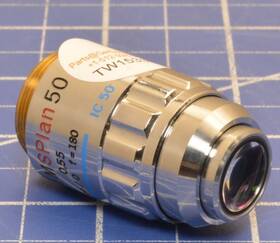
( Brand: Olympus ), ( Manufacturer Part Number: 50X/0.55 ), ( Part Type: Len )
Review OLYMPUS 50x/0.55 /0 180 Msplan 50 0.55 Microscope Objective Lens
The **Olympus MPlan 50x/0.55/0.180 mm Plan Achromatic Objective Lens** is a precision-engineered optical component designed to deliver exceptional clarity, contrast, and resolution for high-magnification microscopy applications. Part of Olympus renowned MPlan series, this objective lens combines advanced optical design with robust mechanical construction to ensure reliable performance across a wide range of biological, materials science, and industrial examinations. With a nominal magnification of **50x**, the lens offers a **numerical aperture (NA) of 0.55**, striking an optimal balance between light-gathering ability and working distance, making it ideal for observing fine structural details in specimens that require both depth and fine resolution. The **0.180 mm cover glass correction** ensures accurate imaging whether the sample is mounted on a standard 0.17 mm or 0.18 mm thick slide, minimizing spherical aberration and enhancing image fidelity. Constructed from high-quality optical glass and coated with proprietary multi-layer anti-reflective and anti-abrasion finishes, this lens minimizes flare, ghosting, and stray light, delivering crisp, distortion-free images even at high magnifications. The **Plan (planapochromatic) design** eliminates curvature of field and lateral chromatic aberration, ensuring a perfectly flat image plane across the entire field of view a critical feature for photomicrography and quantitative analysis. Suitable for use with brightfield, phase contrast, and differential interference contrast (DIC) illumination systems, the MPlan 50x/0.55 lens integrates seamlessly into Olympus modular microscope platforms, offering versatility for both research and educational settings. Its durable metal housing and precision-ground optics are engineered for long-term durability, while the **infinity-corrected** design ensures compatibility with modern microscope configurations, including those equipped with beam splitters and digital cameras. Whether examining cellular structures, thin tissue sections, or fine material samples, this objective lens provides the precision and reliability demanded by demanding microscopy applications, making it an indispensable tool for scientists, researchers, and educators seeking uncompromising optical performance.
The Olympus 50x/0.55 NA Plan 50 objective lens is a high-magnification, oil-immersion objective designed for fluorescence and brightfield microscopy. Below is a detailed breakdown of its pros and cons, followed by a conclusion and recommendation.
---
### **Pros**
1. **High Magnification and Resolution**
The 50x magnification provides a significantly higher level of detail compared to lower-magnification objectives, making it ideal for examining fine cellular structures, subcellular components (e.g., organelles, bacteria, or small particles). The 0.55 numerical aperture (NA) enhances resolution, allowing for clearer visualization of fine details, though it is not the highest NA available for oil immersion (e.g., 1.4 or 1.45 NA objectives offer even better resolution).
2. **Plan-Apochromat Correction**
The "Plan" designation indicates that the objective is corrected for flat-field imaging, reducing curvature of field and spherical aberration. This ensures that the image remains sharp across the entire field of view, which is critical for accurate measurements and documentation. The "Apochromat" correction further minimizes chromatic aberration, improving color fidelity.
3. **Compatibility with Fluorescence**
This objective is designed for fluorescence microscopy, which is essential for imaging labeled samples (e.g., fluorescent proteins, dyes). The 0.55 NA is a balanced choice for many fluorescence applications, offering sufficient light gathering without the complexity or cost of higher NA objectives.
4. **Oil Immersion**
Oil immersion reduces light scattering and increases NA, improving resolution and contrast compared to air objectives. This is particularly useful for high-magnification work where detail is paramount.
5. **Durability and Build Quality**
Olympus objectives are generally well-built, with robust mechanical construction and durable coatings. The 50x Plan 50 is no exception, offering reliability for routine use in research or educational settings.
6. **Compatibility with Olympus Microscopes**
This objective is designed to work seamlessly with Olympus microscope systems, including infinity-corrected and finite-corrected models. It is also often compatible with other high-quality microscope brands, though compatibility should be verified with your specific setup.
7. **Versatility for Specific Applications**
The 0.55 NA is suitable for a wide range of applications, including cell biology, histology, and microbiology. It strikes a balance between resolution and working distance (typically 0.13 mm), making it practical for many samples without requiring excessive immersion oil.
---
### **Cons**
1. **Limited Working Distance**
The working distance (the distance between the objective and the slide) is very short ( 0.13 mm). This can be problematic for thick samples, live-cell imaging, or applications requiring manipulation of the sample (e.g., microinjection or patch-clamping). Higher NA objectives (e.g., 100x/1.4) have even shorter working distances, but the 50x/0.55 is still restrictive compared to lower-magnification objectives.
2. **Requires Immersion Oil**
Oil immersion objectives require the use of immersion oil, which can be messy, expensive, and prone to contamination if not handled carefully. The oil must be compatible with the objective (e.g., type N oil for Olympus) to avoid aberrations. Additionally, oil can degrade over time, requiring replacement.
3. **Cost**
While not the most expensive objective in Olympus's lineup, a 50x Plan 50 objective is still a significant investment, especially for individual researchers or students. The price may be justified for high-end research but could be overkill for basic or low-magnification work.
4. **Sensitivity to Sample Preparation**
High-magnification objectives are sensitive to sample thickness, cover slip thickness, and refractive index mismatches. If the sample is not properly prepared (e.g., uneven thickness, air bubbles under the cover slip), image quality can degrade significantly. This requires careful attention to sample mounting and preparation.
5. **Limited Depth of Field**
The depth of field at 50x magnification is extremely shallow, meaning only a thin section of the sample will appear in focus at any given time. This can be challenging for imaging thick samples or 3D structures without focusing stacks or advanced techniques like confocal microscopy.
6. **Potential for Aberrations**
While the Plan-Apochromat correction minimizes aberrations, improper use (e.g., incorrect oil type, misalignment, or dirty optics) can introduce aberrations such as spherical or chromatic aberration. This requires regular maintenance and careful handling.
7. **Not Ideal for Low-Light Conditions**
While the 0.55 NA is sufficient for many fluorescence applications, it is not optimized for extremely low-light conditions. For such cases, higher NA objectives (e.g., 1.4) or specialized techniques (e.g., total internal reflection fluorescence, TIRF) may be more appropriate.
---
### **Conclusion**
The Olympus 50x/0.55 NA Plan 50 objective is a high-quality, versatile tool for microscopy applications requiring moderate to high magnification with good resolution and flat-field correction. It excels in fluorescence and brightfield imaging of thin samples where fine details are critical. However, its short working distance, requirement for immersion oil, and sensitivity to sample preparation may pose challenges in certain applications. The objective is well-suited for research settings where precision and detail are prioritized but may be less practical for routine, low-magnification, or thick-sample work.
---
### **Recommendation**
**Buy the Olympus 50x/0.55 NA Plan 50 objective if:**- You require high magnification (50x) for detailed imaging of cellular or subcellular structures.
- Your work involves fluorescence microscopy, and you need a balance between resolution and light gathering.
- You are using an Olympus microscope system and have compatible sample preparation techniques.
- You are willing to invest in immersion oil and proper sample mounting to avoid aberrations.
- Your samples are thin and flat, or you are prepared to use focusing stacks for thicker samples.
**Consider alternatives if:**- You frequently work with thick samples or live cells, in which case a lower magnification objective (e.g., 40x) or a higher NA objective (e.g., 100x/1.4) with a longer working distance might be more suitable.
- Your budget is limited, and you can achieve similar results with a lower-cost objective (e.g., a 40x Plan Fluorite).
- You require ultra-high resolution for extremely fine details, in which case a 100x/1.4 or 1.45 NA objective may be preferable.
- Your applications involve low-light conditions or advanced techniques like TIRF, where specialized objectives or systems are needed.
For most research laboratories focused on cell biology, histology, or microbiology, the Olympus 50x/0.55 NA Plan 50 is a solid choice that offers a good balance of performance and versatility. Ensure that your microscope setup, sample preparation, and imaging goals align with the objective s specifications to maximize its utility.
Details:
Your Source for Spares Chiller Repairs. Two-zero-eight-nine-eight-two-one-eight-six-two Direct Line. SN: 104177,TW153393. Pictured items, only, shall be included in the listing.
Applied Materials, Canon, DNS, Ebro,Edwards, ENI, Masonic's, KLA-Tenor, LAM, Nikon, Novellas, Parametric, SVG, TEL,Variant and more. Five-one-two-nine-two-eight-five-five-five-three Corporate Office. If it snot pictured or in the , then is not included. Please Contact.
Weldon't ship to any illegal by US LAW or restricted destinations. Affinity, Baltic's, Ne slab, SMC or Thermos Fisher chillers. Items over 150 lbs. Pallet/crating fees apply.
part #: 50x055 prices
- $70.25-$449.99
specifications microscopepartzo:
- brand: Olympus
- mpn: 50x/0.55
- part type: Len
offer microscopepartzo:
- availability: In Stock
- started: March 16, 2026
- best offers: True
- options: Ship-to-home
- quantity: 1
- sold: 0
shipping microscopepartzo:
- cost: $9.66
- class: Economy, Standard
- carrier: FedEx, UPS
- transit: 3-7 Days
- type: Calculated
- service: FedEx Ground Economy, UPS Ground Saver, UPS Ground, FedEx Ground / FedEx Home Delivery
payments microscopepartzo:
- credit card: Diners-club
- other
- wallet: Apple-pay
seller microscopepartzo:
- # reviews: 1347
- city: Buda, Texas
- rating: 100.0%
general microscopepartzo:
- Medical/Lab Equipment Attachments Accessories > Microscope Parts Accessories > Other Microscope Parts Accessories
- condition: Used
returns microscopepartzo:
- method: Money back
- paid by: Buyer
- policy: Returns Accepted
- time: 14 Days
Olympus 50X-0.55 Is Similar To:
- Fn22 Uis2 Tirf 60x Microscope 1.49 0.13-0.19 Apo Olympus Objective (35.8% similar) Mechanically and optically in excellent condition. Small cosmetic dent on metal housing see last photo but this has no affect on function. RMS threads. Beautiful piece. 14 day money back guarantee if you're not satisfied for any reason...(February 17th, 2015)
- 0.60na Olympus Objective 40x Lwdcdplan (37.7% similar) 60NA objective. Appears clean. Acquired from an optic dealers stock comes as shown. No manuals,no standard power cords, accessories, software etc are included unless pictured and noted in the. Shipping buyer to pay shipping in the us. All equipment is sold as is...(February 21st, 2015)
- Olympus Optics Objective Microscope 75x 0.75x Vm 0 Stereo (38.4% similar) Olympus objective. Used but in great condition...(February 16th, 2015)
- Olympus 0.95na 100x Splan Objective (56.3% similar) 95NA objective 160 tube length , RMS thread dry objective correction collar. 20MM working distance Olympus part 1 LB592. Olympus splan 100X...(March 9th, 2015)
- 0.62ns Olympus Objective Lower Lens (42.7% similar) This is a very nice 110AL0. 62X WD160 lower objective lens...(September 14th, 2018)
- 001270 Olympus Microscope Objective Set (56.1% similar) The unit appears in good condition with no apparent scratches. Device was acquired with other surplus equipment. No documentation available...(April 17th, 2017)
- 00a J71510-1 Dv3385-00 Olympus Arcturus Microscope Power Distribution Circuit Board Pcb (32.3% similar) I combine shipping where practical. They are not included in the items sale price or shipping cost. 95 only what is described as included or shown in the photos. Sorry, no local pick-up for this item. Power control PCB removed from an Olympus IX50 Arcturus pix cell ii - PXL-200 microscope model: Si-...(January 29th, 2019)
- 40 017microscope 0.65 Olympus Objective (40.7% similar) All microscope parts came from a university sale, parts are in good shape as shown. If expedited shipping is necessary for any reason, please prior to purchasing the item. If there is a reason you cannot leave a five star rating, please for resolution. Pics are of actual item being sold. I do try to...(February 1st, 2015)
- 044550 Olympus Microscope Bh Dual Observation Attachment (43.5% similar) Olympus microscope bah BH2 dual observation attachment w 9B2652 physical condition: this unit has some minor scuffing on casing from average use. Unit looks to be in great condition. Lens look clean...(June 15th, 2018)
- Adapter 0.5x Leica 1.0xlens Leitz Microscope 3 2 Camera Iso38 Olympus Nikon M4 (28.8% similar) Assembly pieces minus. The adapter uses a standard ISO 38MM x c mount LTZ Leila wild ISO 38. The device is designed to insert into any microscope which contains a 38MM photo port bottom lower portion of picture. 0x port adapter see picture below for separate parts. 0x with f mount. 54 5, 31, 6, 49 ...(February 13th, 2015)
- 1-25p-ahlx-4 Arcturus Labs Iphone Microscope Adapter For Photoport Leitz Nikon Olympus (32.5% similar) They clamp on to the viewing ocular but this prevents microscope from being used with your camera in position these inclined oculars. This one unit is for the iPhone 4 or 4S. Be sure it is 1x without an optic. Also works on microscopes usually inverted type with side camera ports and 1x c-mount ...(April 30th, 2018)
