NIKON 96157 Fluorescence Filter Cube Rfp Tritc Txred Mcherry G-2E/C
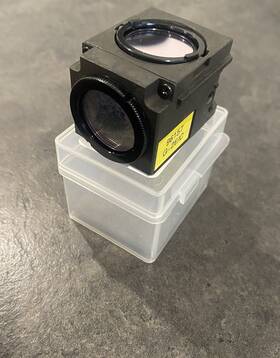
( Brand: Nikon ), ( Manufacturer Part Number: 96157 ), ( Part Type: Filter )
Review NIKON Fluorescence Filter Cube G-2e/c Rfp Tritc Txred Mcherry Used
Nikon 96157 Fluorescence Filter Cube G-2E/C RFP-Tritc-TxRed-mCherry
The Nikon 96157 Fluorescence Filter Cube G-2E/C RFP-Tritc-TxRed-mCherry is a precision engineered optical accessory designed for high-performance fluorescence microscopy. This filter cube is meticulously crafted to optimize the excitation and emission of specific fluorophores, facilitating clear and vibrant imaging of specimens labeled with these fluorescent markers.
The filter cube is comprised of four distinct filter components: a 546/12 nm excitation filter for RFP (Red Fluorescent Protein), a 568 nm dichroic mirror for efficient beam splitting, a 607/52 nm emission filter for Tritc (Tetramethylrhodamine), a 617 nm dichroic mirror for further beam splitting, a 650/75 nm emission filter for TxRed (Texas Red), and a 660 nm dichroic mirror for the final beam splitting. Additionally, it includes a 624 nm emission filter for mCherry fluorescence.
The Nikon 96157 Fluorescence Filter Cube G-2E/C RFP-Tritc-TxRed-mCherry is designed with Nikon's renowned commitment to quality and innovation. Its multilayer coating minimizes stray light and maximizes transmission efficiency, ensuring optimal signal-to-noise ratio in your imaging experiments. This filter cube is compatible with Nikon's CFI60 and CFI90 series objectives, making it an ideal choice for researchers and microscopists who demand exceptional performance and versatility.
In summary, the Nikon 96157 Fluorescence Filter Cube G-2E/C RFP-Tritc-TxRed-mCherry is an essential tool for fluorescence microscopy, offering exceptional optical performance and versatility for the excitation and emission of RFP, Tritc, TxRed, and mCherry fluorophores. Whether you're studying cell biology, neuroscience, or other fields that rely on fluorescence microscopy, this filter cube is an indispensable addition to your research toolkit.
The Nikon 96157 Fluorescence Filter Cube G-2E/C RFP TRITC TXRED MCHERRY is a specialized tool designed for fluorescence microscopy, specifically for working with red, green, and far-red fluorophores like RFP (Red Fluorescent Protein), TRITC (Tetramethylrhodamine), TXRED (Texas Red), and MCHERRY. Here are some pros and cons to help you make an informed decision:
Pros:1. High-Quality Optics: Nikon is a reputable brand known for its high-quality optics, ensuring accurate and vivid fluorescence detection.
2. Broadband Filters: The filter cube provides broadband excitation and emission filters, which allow for the observation of multiple fluorophores simultaneously.
3. Compatibility: This filter cube is designed to work with Nikon microscopes, ensuring seamless integration.
4. Durable Construction: The filter cube is built to withstand regular use in a laboratory setting.
Cons:1. High Cost: High-quality optics come at a premium, making this filter cube a significant investment.
2. Limited Compatibility: This filter cube is designed specifically for Nikon microscopes, which may limit its usefulness if you switch to a different brand in the future.
3. Requires Specific Light Sources: The filter cube requires specific excitation light sources, which may not be included with your microscope and must be purchased separately.
In conclusion, the Nikon 96157 Fluorescence Filter Cube G-2E/C RFP TRITC TXRED MCHERRY is a high-quality tool for fluorescence microscopy. If you're a researcher working with the specified fluorophores and have a Nikon microscope, this filter cube could be a valuable addition to your laboratory. However, its high cost and limited compatibility with other microscope brands are important factors to consider before making a purchase. If you're unsure about your specific needs, it may be worth consulting with a microscopy expert or researching other filter cube options.
Details:
Shows signs of degradation on filters. Tested and still shows fluorescent signal.
part #: 96157 price
- $1795.00
specifications microscopepartzo:
- brand: Nikon
- mpn: 96157
- part type: Filter
shipping microscopepartzo:
- transit: 7-12 Days
- service: UPS Ground Saver
- carrier: UPS
- cost: $0.00
- type: Fixed
- class: Economy
seller microscopepartzo:
- rating: 100.0%
- city: Shawnee, Kansas
- # reviews: 180
general microscopepartzo:
- Medical/Lab Equipment Attachments Accessories > Microscope Parts Accessories > Other Microscope Parts Accessories
- condition: Used
payments microscopepartzo:
- wallet: Apple-pay
- credit card: Discover
- other
offer microscopepartzo:
- options: Ship-to-home
- quantity: 1
- started: August 14, 2024
- best offers: True
- sold: 0
- availability: In Stock
returns microscopepartzo:
- policy: No Returns
Nikon 96157 Is Similar To:
- 233038 Nikon Japan Fluorescence Microscope Vertical Attachment With Filter (35.1% similar) Will try to assist in any further questions about this item. Comes with ND2 ND4 slide in filters...(May 26th, 2018)
- 30213 Nikon Microscope Camera Filter Unit With (38.3% similar) Have a lovely day. Make an offer. Feel free to contact me with any questions...(February 26th, 2018)
- 32-1003a-310 Ccd Camera Filter Slider Qimaging Nikon Rgb (27.7% similar) Imaging Nikon GB slider filter 32 1003A 310 for CDC camera here is a nos imaging Nikon GB slider filter 32 1003A 310 for CDC camera, in mint unused condition in the original unopened package Weeks will combine on shipping. The slider provides for easy switching from color to monochrome imaging. ...(February 8th, 2015)
- 400nm Chroma Dichroic Mirror Nikon Microscope Fluorescence Filter (37.4% similar) Chrome 400NM dishrag mirror Nikon microscope fluorescence filter dimensions: 2MM x 26MM 38MM filters are in good optical condition...(November 2nd, 2018)
- 451f550 Olympus New Nikon Microscope Filter (29.1% similar) Two new Nikon Olympus filter 45MM one is 451F550 yellow, another c blue. Lot...(December 30th, 2018)
- 49004 Chroma Et Tritc Unmounted Nikon Microscope Filter Set (30.1% similar) ...(April 2nd, 2018)
- 4s008-035 Nikon Lamp Control Module With Interface Cables Nsr Series Used (38.1% similar) The physical condition is good, but there are signs of previous use and handling. Serial numbers or country of manufacture may vary. The bureaus of us. Only items pictured are included: if a part is not pictured, or mentioned above, then it included in the sale. Specifications part no: 4S008-035 ...(October 24th, 2018)
- 511288 Nikon Customizable Filter Cubes (39.3% similar) These filter cubes blocks are designed for Nikon TE2000 ti microscopes and can accommodates dishrags up to 3MM in thickness - ideal critical applications such as turf, structured illumination, super-resolution image-splitting. Filters can be easily swapped if needed, giving you great flexibility. ...(April 4th, 2017)
- Nikon 585nm Filter Fluorescence Yellow Quadfluor Cube Eclipse Chroma (46.5% similar) Mechanically and optically in excellent condition. Excitation 585 50NM dishrag 625NM emission 675 50NM this metal cube is compatible with Nikon's e2 e4 e6 e8 E10 TS1 TS100F, TE2 TE3 ME600L, L150A microscopes. Excitation filter has some speckling but this does not affect function...(February 28th, 2015)
- Nikon Priced Green 33mm Filter Whs5 76238 Sell (37.7% similar) Surplus microscope related parts Nikon 33MM green filter priced to sell...(January 17th, 2015)
- 82907 Nikon Volpi Microscope Filter (33% similar) 2MM in diameter. This filter holder has a Nikon number of: 82907 and vol pi for microscope fiber-optic Illuminati. It will accept a filter of and is new in original packing...(November 19th, 2017)
