NIKON CY5-4040C Fluorescence Filter Cube Eclipse Microscope
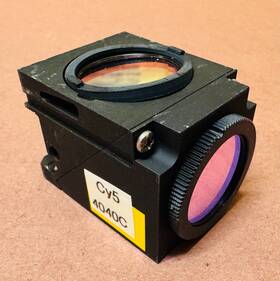
( Brand: Nikon ), ( Manufacturer Part Number: CY5-4040C ), ( Model: CY5 4040C ), ( Part Type: Filter ), ( Country Of Origin: Japan ), ( Intended Use/discipline: Biological Laboratory, Medical Laboratory, Microbiological Laboratory )
Review NIKON Cy5 Fluorescence Filter Cube Eclipse Microscope
The **Nikon CY5-4040C Fluorescence Filter Cube** is a high-performance, precision-engineered optical component designed exclusively for the Nikon Eclipse series of fluorescence microscopes, offering unparalleled clarity and efficiency for imaging samples labeled with Cy5 fluorophores. This filter cube is meticulously crafted to isolate and enhance the distinct emission spectrum of Cy5, a near-infrared dye widely utilized in biological research for its exceptional photostability and deep tissue penetration capabilities. The CY5-4040C incorporates a **dual-band excitation filter**, strategically combining a long-pass filter to block shorter wavelengths while allowing the specific excitation range of Cy5 (approximately 630 650 nm) to pass through, ensuring minimal autofluorescence interference and optimal excitation efficiency. The **emission filter** within the cube is a high-quality long-pass design, meticulously optimized to transmit the characteristic Cy5 emission spectrum (around 670 nm and above) while effectively blocking any stray light, thereby maximizing signal-to-noise ratio and contrast in your fluorescence images. The dichroic mirror, a critical component of the filter cube, is engineered with precision to reflect the excitation light toward the sample while allowing the emitted fluorescence to pass through to the detection system without significant loss, thus preserving the integrity of your imaging data. Built to Nikon s rigorous standards, this filter cube is constructed with durable, long-lasting materials that ensure consistent performance across extended periods of use, making it an ideal choice for both routine and high-demand fluorescence microscopy applications. Whether you are studying cellular processes, tracking molecular interactions, or analyzing complex tissue samples, the CY5-4040C delivers the reliability and precision required to capture high-quality, reproducible results with minimal maintenance. Its seamless integration with the Nikon Eclipse microscope system further enhances its functionality, providing researchers with a versatile tool for advancing their fluorescence imaging studies.
The Nikon Cy5-4040C fluorescence filter cube is designed for imaging fluorophores that emit in the far-red spectrum, primarily Cy5 dyes. Below is a detailed analysis of its pros and cons, followed by a conclusion and recommendation.
---
**Pros:**1. **High Sensitivity for Far-Red Fluorophores:** The filter cube is optimized for Cy5, a dye commonly used in biological imaging for labeling proteins, nucleic acids, or other targets. Cy5 emits in the far-red region (around 670 nm), which minimizes autofluorescence from biological samples and allows for deeper tissue penetration compared to shorter wavelengths.
2. **Compatibility with Nikon Microscopes:** As a Nikon-specific filter cube, it is designed to integrate seamlessly with Nikon Eclipse microscopes, ensuring optimal alignment and performance. This reduces the risk of misalignment issues that can occur with third-party filters.
3. **Reduced Phototoxicity and Bleaching:** Far-red excitation (typically around 630 650 nm) is less damaging to live cells than shorter wavelengths (e.g., UV or blue), making this filter cube suitable for long-term imaging of live samples.
4. **Minimized Autofluorescence:** Biological samples often exhibit autofluorescence in the green-yellow range, which can interfere with imaging. The far-red emission of Cy5 avoids this overlap, resulting in cleaner images with less background noise.
5. **Compatibility with Multiplex Imaging:** Cy5 can be used alongside other fluorophores (e.g., FITC, Cy3, or DAPI) in multiplex imaging experiments, provided the excitation and emission spectra do not overlap significantly. This filter cube can be part of a larger imaging strategy for labeling multiple targets in a single sample.
6. **Durability and Quality:** Nikon filter cubes are generally built to high standards, with precise optical coatings and durable materials. This reduces the likelihood of degradation over time, especially important for high-throughput or long-term use.
7. **Support and Warranty:** Purchasing from Nikon ensures access to technical support and warranty coverage, which can be valuable if issues arise with the filter cube or its integration with the microscope.
---
**Cons:**1. **Limited Fluorophore Compatibility:** The filter cube is specifically designed for Cy5 and may not be suitable for other far-red fluorophores with slightly different emission spectra (e.g., Cy5.5 or Cy7). Using it with non-Cy5 dyes could result in suboptimal imaging performance or background interference.
2. **Cost:** Nikon filter cubes are typically more expensive than third-party alternatives. For researchers on a tight budget, this may be a significant drawback, especially if the filter cube is not frequently used.
3. **Excitation Light Source Requirements:** Far-red excitation often requires a high-power light source (e.g., a mercury lamp with a far-red filter or a laser). Some Nikon microscopes may not include this capability by default, requiring additional hardware (e.g., a laser module or specialized lamp filter), which adds to the cost.
4. **Potential for Overlap with Other Fluorophores:** While Cy5 is distinct from many common fluorophores, there is still a risk of spectral overlap with other far-red dyes (e.g., Alexa Fluor 647) or autofluorescent compounds in some samples. This may necessitate additional controls or spectral unmixing to ensure accurate imaging.
5. **Limited Availability of Spare Parts:** If the filter cube fails or requires maintenance, spare parts or replacements may not be as readily available as for more commonly used filter cubes (e.g., those for FITC or DAPI). This could lead to downtime if the microscope relies heavily on Cy5 imaging.
6. **Compatibility with Older Microscopes:** If the microscope is an older model, it may not support the optical requirements of the Cy5 filter cube (e.g., proper dichroic mirror alignment or lamp compatibility). This could necessitate upgrades or modifications to the microscope setup.
7. **Learning Curve for Multiplex Imaging:** While Cy5 can be used in multiplex experiments, setting up and optimizing such experiments requires careful planning to avoid cross-talk between fluorophores. Researchers new to multiplex imaging may need additional training or resources to achieve optimal results.
---
**Conclusion:**The Nikon Cy5-4040C fluorescence filter cube is a high-quality, specialized tool for imaging Cy5-labeled samples, offering significant advantages in terms of sensitivity, reduced phototoxicity, and compatibility with Nikon microscopes. Its strengths make it an excellent choice for applications requiring far-red imaging, such as live-cell imaging, deep-tissue imaging, or multiplex experiments involving Cy5. However, its limitations including cost, limited fluorophore compatibility, and potential hardware requirements may not make it suitable for all users. Researchers should carefully consider their specific needs, budget, and existing microscope setup before purchasing.
---
**Recommendation:** Purchase the Nikon Cy5-4040C filter cube if:- You are working with Cy5-labeled samples and require high-quality far-red imaging.
- Your microscope is a Nikon Eclipse model that is compatible with the filter cube.
- You have a reliable light source (e.g., a lamp with far-red capability or a laser) for excitation.
- You prioritize durability, support, and integration with Nikon s ecosystem over cost savings.
- You plan to use Cy5 in multiplex imaging or applications where reduced phototoxicity is critical.
Consider alternative options if:- You are working with a different far-red fluorophore (e.g., Cy5.5 or Cy7) and need a more broadly compatible filter cube.
- Budget constraints make the Nikon filter cube prohibitively expensive, and third-party alternatives are available with similar performance.
- Your microscope lacks the necessary hardware (e.g., far-red excitation source) to fully utilize the filter cube, and upgrading is not feasible.
- You require a filter cube for frequent use with multiple fluorophores, and a more versatile cube (e.g., a broad-spectrum far-red cube) would be more practical.
For researchers on a budget or those needing broader compatibility, third-party filter cubes (e.g., from Chroma or Semrock) may offer comparable performance at a lower cost. However, if compatibility with Nikon s ecosystem and long-term reliability are priorities, the Cy5-4040C is a strong choice.
Details:
Excellent condition. Nikon Cy5 4040C Fluorescence Filter Cube For Eclipse Microscope.
part #: cy54040c prices
- $795.00-$998.00
specifications microscopepartzo:
- brand: Nikon
- mpn: Cy5-4040c
- model: Cy5 4040c
- part type: Filter
- country of origin: Japan
- intended use/discipline: Biological Laboratory, Medical Laboratory, Microbiological Laboratory
offer microscopepartzo:
- availability: In Stock
- options: Ship-to-home
- sold: 0
- started: February 19, 2026
- quantity: 1
general microscopepartzo:
- Medical/Lab Equipment Attachments Accessories > Microscope Parts Accessories > Other Microscope Parts Accessories
- condition: Used
shipping microscopepartzo:
- transit: 4-9 Days
- carrier: USPS
- service: USPS Ground Advantage
- class: Standard
- cost: $0.00
- type: Calculated
payments microscopepartzo:
- credit card: Diners-club
- wallet: Apple-pay
- money order
- other
seller microscopepartzo:
- # reviews: 26245
- rating: 99.9%
- city: Riverview, Florida
returns microscopepartzo:
- time: 14 Days
- paid by: Buyer
- method: Money back
- policy: Returns Accepted
Nikon CY5-4040C Is Similar To:
- Mrd00100 Nikon Eclipse Microscope Plan Apo Dic Infinity Objective (34.5% similar) Original, new MRD00100. Working distance. List price: 1, comes with original capsule for protection when stored...(March 11th, 2018)
- 0.001mm Micrometer Microscope Vernier Nikon (32.8% similar) Received as surplus manufacturer Nikon vernier model could not find one do not know much about microscopes it moves back and forth and the rod goes in and out I am unable to test any further that is why I have to sell for parts or repair I only have what is pictured if you would like more pictures ...(February 2nd, 2015)
- 0.075 Nikon Optiphot Objective Plan Lens 2.5x 210 0 Microscope (31.1% similar) Posted with mobile. Nikon m plan 5x objective used for uptight and other microscopes. Beautiful clear, clean optics, no scratches on the tube...(January 18th, 2015)
- Adaptor Lens 0.55x Relay Tv Microscope Brand Nikon mount (24.6% similar) 55X c mount adapter for Nikon e2 e4 e8 50 55, ci, ts, LV150 series MQD42055 Nikon oem LV100 LV150 L200 300MM 800 400 microscope...(January 4th, 2015)
- 0.8-3.5x Stereo Zoom Sell Body Priced Microscope Smz-445 Nikon 45 Whs5 (30.3% similar) 5x 45 body great deal new in box priced to sell. Nikon DMZ 445 zoom stereo microscope...(January 21st, 2015)
- 0.27x Nikon Objective Lens For Microscope (45.6% similar) No manuals,no standard power cords, even if it appears in the photo, accessories, software etc are included unless pictured and noted. You can also after a sale if have return issues or any other concerns. All equipment is sold-as-is. All statements regarding products and their configurations are ...(February 9th, 2017)
- 021659 Nikon Binocular Teaching Microscope Head (40% similar) Nikon binocular teaching microscope head...(December 3rd, 2018)
- 032043 And 032061 Nikon Double Trinocular Head For Microscope Good Cosmetic Condition (31.6% similar) As shown in the photos. Shipping: if there is a shipping cost shown in the offer, it for continental us 48 states. Please look closely at the pictures. The lens appear to be scratch free. This item is in good cosmetic condition. Unable to test due lack of necessary equipment needed. Item is sold as ...(May 23rd, 2018)
- 05labonikon Nikon Labophot Microscope Camera Kit Lens Dx Apophot Opti Alp (27.4% similar) A Nikon t2 bayonet and to c mount with. 5x lens for SLR or milch cameras. Camera model's adapter attached to Nikon with an AP's-c sensors in particular the DX. This allows you to use. See example pictures below. 2 no adapter used ,30, and 30. If your microscope has this tube inside you can use the ...(April 9th, 2018)
- Adapter 0.5x Leica 1.0xlens Leitz Microscope 3 2 Camera Iso38 Olympus Nikon M4 (22.5% similar) Assembly pieces minus. The adapter uses a standard ISO 38MM x c mount LTZ Leila wild ISO 38. The device is designed to insert into any microscope which contains a 38MM photo port bottom lower portion of picture. 0x port adapter see picture below for separate parts. 0x with f mount. 54 5, 31, 6, 49 ...(February 13th, 2015)
- 1-25p-ahlx-4 Arcturus Labs Iphone Microscope Adapter For Photoport Leitz Nikon Olympus (27.7% similar) They clamp on to the viewing ocular but this prevents microscope from being used with your camera in position these inclined oculars. This one unit is for the iPhone 4 or 4S. Be sure it is 1x without an optic. Also works on microscopes usually inverted type with side camera ports and 1x c-mount ...(April 30th, 2018)
