LEITZ D1.20A Ernst Wetzlar Microscope Darkfield Oil Condenser
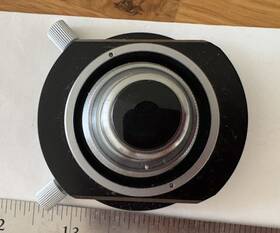
( Brand: Leitz ), ( Manufacturer Part Number: D1.20A ), ( Part Type: Oil Condenser ), ( Country Of Origin: Germany ), ( Intended Use/discipline: Biological Laboratory, Microscope Darkfield Oil Condenser )
Review LEITZ Ernst Wetzlar Microscope Darkfield Oil Condenser1.20
The **Leitz D1.20A Ernst Wetzlar Darkfield Oil Condenser (NA 1.20)** is a meticulously crafted, high-performance optical component designed for advanced microscopy applications where illumination contrast and resolution are paramount. Engineered by the legendary German optics manufacturer Ernst Leitz (now part of Leica Microsystems), this condenser represents a pinnacle of precision and durability, embodying the craftsmanship that has made Wetzlar a byword for excellence in scientific instrumentation. With a numerical aperture of **1.20**, this darkfield condenser is optimized for illuminating specimens with oblique light, creating a striking halo effect around transparent or unstained samples that enhances fine structural details such as bacterial flagella, thin tissue sections, or delicate cellular components that might otherwise remain invisible under conventional brightfield illumination. The **oil immersion design** ensures minimal light scattering and maximum light gathering, while the **apochromatic correction** minimizes chromatic aberrations, delivering a sharp, distortion-free image across the entire field of view. Constructed from high-quality optical glass and precision-ground components, the condenser features a robust, metal housing with fine-threaded mounting for seamless integration into Leitz or compatible microscopes, ensuring stability and alignment. Its **adjustable diaphragm** allows for precise control over the cone of illumination, enabling users to fine-tune contrast and depth perception for optimal visualization. Whether employed in bacteriology, parasitology, or materials science, this condenser is a testament to the enduring legacy of German optical engineering, offering researchers and microscopists a reliable tool for pushing the boundaries of what can be observed under the microscope.
### **Pros and Cons of the Leitz D1.20A (Ernst Wetzlar) Darkfield Oil Condenser (NA 1.20)**
#### **Pros**
1. **High Numerical Aperture (NA 1.20)** This condenser is designed for high-resolution darkfield microscopy, allowing for superior contrast and detail in transparent specimens. The high NA is particularly useful for observing fine structures in biological samples, such as bacteria, thin tissue sections, or small particles.
2. **Darkfield Illumination** Darkfield microscopy enhances contrast by illuminating the specimen from the side, making it ideal for observing unstained or lightly stained samples. This is advantageous in fields like microbiology, where staining can alter or obscure natural structures.
3. **Oil Immersion Compatibility** The condenser is designed for oil immersion, which reduces light scattering and improves resolution. This is essential for high-magnification work where fine details must be observed.
4. **Historical and Collectible Value** The Leitz D1.20A is a classic piece of optical equipment from Ernst Wetzlar (a precursor to Leica Microsystems). It holds historical significance and may appeal to collectors or enthusiasts of vintage microscopes.
5. **Compatibility with Leitz Microscopes** If you already own or plan to use a Leitz microscope (such as a Leitz Ortholux or similar), this condenser will integrate seamlessly with the optical system.
6. **Durability and Craftsmanship** Leitz/Wetzlar microscopes were known for their precision engineering and durability. While older models may require maintenance, a well-preserved D1.20A can be a reliable component.
7. **Versatility in Applications** Beyond microbiology, darkfield microscopy is useful in materials science, mineralogy, and even some forms of industrial inspection where contrast is critical.
---
#### **Cons**
1. **Age and Wear** As a vintage condenser, the D1.20A may show signs of aging, such as:- **Optical degradation** (scratches, yellowing of lenses, or misalignment).
- **Mechanical wear** (loose parts, rust, or difficulty in focusing).
- **Electrical issues** (if the condenser includes an illumination component, bulbs or wiring may need replacement).
A thorough inspection by an optics specialist is recommended before purchase.
2. **Maintenance Requirements** Older optical components often require cleaning, realignment, or recoating to restore performance. This can be costly and time-consuming.
3. **Limited Availability of Parts** Finding replacement parts, especially for vintage Leitz/Wetzlar equipment, can be difficult. Some components may no longer be manufactured, requiring sourcing from collectors or specialty suppliers.
4. **Compatibility Issues** While designed for Leitz microscopes, ensuring a perfect fit with modern or non-Leitz systems may require adapters or modifications. The thread size, centering mechanism, and illumination setup must align correctly.
5. **Cost of Restoration** If the condenser is in poor condition, restoring it to working order may cost more than purchasing a modern equivalent. A functional but heavily used D1.20A might require significant investment in cleaning, alignment, and potential lens recoating.
6. **Modern Alternatives Exist** Contemporary darkfield condensers (e.g., from Leica, Olympus, or Nikon) offer similar or superior performance with warranties, easier maintenance, and better integration with modern microscopes. For most users, a newer condenser may be a more practical choice.
7. **Learning Curve** Darkfield microscopy has a steeper learning curve than brightfield or phase-contrast techniques. Proper alignment and illumination settings are critical for optimal results, and a vintage condenser may not include modern user-friendly adjustments.
---
### **Ending Conclusion**
The **Leitz D1.20A darkfield oil condenser (NA 1.20)** is a remarkable piece of optical history with exceptional capabilities for high-contrast darkfield imaging. Its high numerical aperture and darkfield illumination make it invaluable for specific applications in microbiology, materials science, or historical research. However, its age introduces practical challenges, including potential wear, maintenance costs, and part availability.
If you are a **collector, a historian of microscopy, or a researcher with a specific need for vintage darkfield optics**, this condenser could be a worthwhile acquisition provided it is thoroughly inspected and restored if necessary. For **modern laboratories or general microscopy**, the risks and costs of maintaining a vintage condenser often outweigh its benefits, and a contemporary alternative may be more practical.
### **Recommendation**
- **Buy if:**- You are a collector or enthusiast of vintage microscopes and can justify the investment in restoration.
- You have a specific application (e.g., studying rare historical samples) where the condenser s unique characteristics are essential.
- You are already part of a Leitz microscope system and need a compatible darkfield condenser.
- You are prepared to invest time and money in restoring and maintaining the condenser.
- **Avoid buying if:**- You need a reliable, low-maintenance condenser for routine use in a modern lab.
- You cannot afford or are unwilling to undertake the restoration process.
- You can achieve similar results with a newer, more accessible darkfield condenser.
- The condenser is in poor condition without professional assessment (purchase only after consulting an optics specialist).
For most users today, a **modern darkfield condenser (e.g., Leica DM, Olympus U-DA, or Nikon CFI Dark)** offers better reliability, ease of use, and support while delivering comparable or superior performance. However, if you are drawn to the historical and technical legacy of the Leitz D1.20A, it remains a fascinating and capable tool for the right user.
Details:
It requires immersion oil between the condenser and slide to function. Depending on volume of orders: up to twice per week. Need to use a different address. Orders are collected and shipped out once per week.
Input that address when you purchase.
part #: d120a price
- $149.00
specifications microscopepartzo:
- brand: Leitz
- mpn: D1.20a
- part type: Oil Condenser
- country of origin: Germany
- intended use/discipline: Biological Laboratory, Microscope Darkfield Oil Condenser
seller microscopepartzo:
- city: Rockville, Maryland
- # reviews: 92
- rating: 100.0%
payments microscopepartzo:
- credit card: Visa
- wallet: Google-pay
- other
offer microscopepartzo:
- sold: 0
- started: March 8, 2026
- availability: In Stock
- best offers: True
- options: Ship-to-home
- quantity: 1
returns microscopepartzo:
- policy: No Returns
general microscopepartzo:
- condition: Used
- Medical/Lab Equipment Attachments Accessories > Microscope Parts Accessories > Other Microscope Parts Accessories
shipping microscopepartzo:
- transit: 4-8 Days
- type: Calculated
- cost: $9.06
- service: UPS Ground
- carrier: UPS
- class: Standard
Leitz D1.20A Is Similar To:
- 14239 Leitz Erinst Wetzlar Gmbh Universal Handgrip Model (40.9% similar) Leitz Ernst wetzlar gumbo universal hand grip model with shoulder stock new in box condition is new. Shipped with USPS priority mail...(February 25th, 2019)
- 170 0-2300 Leitz Microscope 1 Wetzlar Lens 22 Objective Oel 0.65 (38.2% similar) Every buyer gets a invitation for cash back. Fungus and haze free...(February 13th, 2015)
- 004229 Leitz Wetzlar 6 Slot (35.1% similar) ...(April 23rd, 2017)
- 00798716162494 Ernst Leitz Wetzlar Vintage 3 (33.3% similar) There are no stage clips. Leitz wetzlar objective. I could focus on a dollar bill and see everything perfectly. Nice vintage ernst Leitz wetzlar microscope with a 35X USA made objective, Busch and limb 97X oil objective no. The paint is in pretty good condition, but it chipped some areas. 5 eye ...(December 26th, 2016)
- 170 Objective 0.95 Wetzlar 011-023 Leitz Apo 40 (27.4% similar) To the lower 48 states...(February 8th, 2015)
- 020-435031 Ernst Leitz Wetzlar Gmbh Fluorescence Microscope Type Parts Only (45.5% similar) Ernst Leitz wetzlar gumbo fluorescence microscope type 020-435031USED, clean lens, no power unit, bulb provided only main body exist, all switches are adjustable please see pictures for details sale parts onyas is, return...(November 19th, 2018)
- 020-448.012 Ernst Leitz Wetzlar Gmbh (32.1% similar) This is a ernst Leitz wetzlar gumbo. F objective LENSES:10X 20X microscope this is in good working and physical condition eyepiece: 15XW...(July 8th, 2017)
- 020-501.015 Leitz Ergolux Amc Wetzlar (29.9% similar) Lenses rotate when button is pushed 4 of 5, one missing. Being sold for parts only not working. Made in germany. Very heavy like a tank. 015 missing the whole focus stage. Lens selector works great. Missing parts non functional. Wow a Leitz ergo lux Mac triangular microscope parts only...(January 21st, 2018)
- 020-507.010 Leitz Leica Biomed Microscope Includes Objectives (39.7% similar) Leila Leitz boomed. 90 condenser eff Leitz OBJECTIVE4. 17 eff Leitz OBJECTIVE10 microscope wit Periclean 10X 18 eyepiece objective includes everything you see in the listing. 17 eff Leitz OBJECTIVE40 oil microscope pair of 10X 18 Periclean eyepieces stage with A0. You are buying on a working great ...(April 2nd, 2018)
- 026-407.110 Ernst Leitz Wetzlar 3008 (32.1% similar) This item is in full working condition with normal wear. Feel free to call us at or contact through messages. Item condition: this is in full working condition with normal wear. Gets you noticed. Our primary carriers are USPS and FedEx. We carefully test and examine each item before listing it on. ...(December 20th, 2017)
- 0.30d Pl 16x Lens 0 Leitz Wetzlar 50 (28.3% similar) 30D lens good condition, no longer needed here. For sale Leitz wetzlar pl 16X...(August 26th, 2015)
