ANDOR DR-328G-C02-SIL Microscope Camera Clara
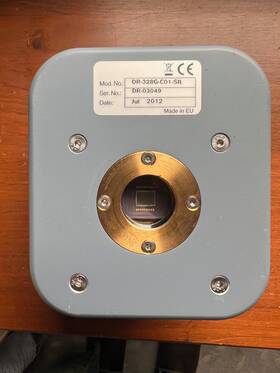
( Brand: Andor ), ( Manufacturer Part Number: DR-328G-C02-SIL ), ( Part Type: Camera )
Review ANDOR Microscope Camera Clara Model
The **Andor Clara E-328G-C02-SIL** is a high-performance, scientific-grade digital camera designed to deliver exceptional image quality and reliability for advanced microscopy applications. Engineered by Andor Technology, a leader in photonics and imaging solutions, this monochrome, back-illuminated CCD camera is optimized for demanding research environments where precision, sensitivity, and speed are critical. Its **16-bit analog-to-digital converter (ADC)** ensures superior dynamic range, capturing subtle variations in sample contrast with remarkable clarity, while the **1024 1024 pixel resolution** provides fine spatial detail essential for high-magnification imaging, such as fluorescence microscopy, confocal microscopy, and live-cell imaging. The camera s **back-illuminated (BI) sensor** enhances quantum efficiency, particularly in the visible and near-UV spectrums, making it ideal for low-light conditions where traditional front-illuminated sensors would struggle. With a **cooling capability down to -35 C**, the Clara E-328G-C02-SIL minimizes thermal noise, further improving signal-to-noise ratios in long-exposure or low-light imaging scenarios, such as fluorescence tagging or single-molecule studies.
Built with durability in mind, this camera features a robust **silicon housing** that protects against environmental factors, ensuring stability in laboratory settings where vibrations or temperature fluctuations could otherwise compromise image integrity. Its **high-speed readout** achieved through a **16 MHz clock speed** allows for rapid frame acquisition, making it suitable for dynamic processes like time-lapse imaging or high-speed confocal scanning. The Clara E-328G-C02-SIL integrates seamlessly with Andor s **Solis** software suite, offering intuitive control over exposure settings, gain adjustments, and real-time image preview, while also supporting third-party software for automated data acquisition and analysis. Whether used in cellular biology, materials science, or neuroscience, this camera s combination of **high sensitivity, low noise, and precise control** makes it an indispensable tool for researchers seeking uncompromising image quality in their microscopy workflows. Its compact yet sturdy design also ensures compatibility with a wide range of microscope models, from inverted to upright systems, while its **USB 3.0 interface** facilitates high-bandwidth data transfer for efficient workflow management.
The **Andor Clara DR-328G-C02-SIL** is a high-end scientific CMOS (sCMOS) camera designed for advanced microscopy applications, particularly fluorescence and live-cell imaging. Below is a detailed breakdown of its pros and cons, followed by a conclusion and recommendation.
---
### **Pros of the Andor Clara DR-328G-C02-SIL**
1. **Exceptional Sensitivity and Low Read Noise**
The camera features Andor s **DR (Direct Readout) sCMOS technology**, which combines high quantum efficiency (QE) with low read noise (as low as 0.9 electrons RMS). This makes it ideal for detecting faint signals in low-light conditions, such as single-molecule imaging or weak fluorescence.
2. **High Dynamic Range**
With a dynamic range of **16-bit**, the camera captures both bright and dim signals within a single exposure, reducing the need for multiple exposures or HDR techniques. This is particularly useful in live-cell imaging where contrast varies significantly across the field of view.
3. **Fast Frame Rates**
The **328 328 pixel sensor** (with optional binning) allows for relatively high frame rates (up to ** 30 fps at full resolution** with minimal readout noise), making it suitable for dynamic processes like calcium imaging, fluorescence recovery after photobleaching (FRAP), or fast kinetics studies.
4. **Low Dark Current**
The camera has a **very low dark current** (typically
5. **High Quantum Efficiency (QE)**
The sensor achieves ** 90% QE at 550 nm**, one of the highest in its class, ensuring maximum photon capture efficiency for fluorescence applications.
6. **Silent Operation**
The **"Silent" mode** reduces mechanical noise from the shutter, which is beneficial for high-precision imaging where vibrations could introduce artifacts.
7. **Compatibility with Andor s Software Suite**
The camera integrates seamlessly with **Andor s Solis software**, which offers advanced features like **autofocus, drift correction, and multi-dimensional data acquisition**. It also supports ** Manager, MetaMorph, and other third-party imaging software**.
8. **Compact and Robust Design**
The camera is designed for **microscope compatibility**, with a **C-mount or S-mount adapter** (depending on the model variant) and a sturdy build for laboratory use.
9. **Low Light Lag**
Andor s sCMOS sensors are engineered to minimize **light lag** (the persistence of signal after exposure), which is crucial for time-lapse imaging where artifacts could distort results.
10. **Global Shutter Capability (Optional)**
While not a true global shutter, the camera supports **rolling shutter correction techniques** and can be paired with systems that mitigate rolling shutter artifacts.
11. **Long-Term Stability**
Andor cameras are known for their **reliability and longevity**, with many users reporting minimal degradation over years of use.
12. **Support for Advanced Filter Wheels and Illumination**
The camera works well with **Andor s filter wheels and LED illumination systems**, enabling flexible experimental setups for multi-channel imaging.
---
### **Cons of the Andor Clara DR-328G-C02-SIL**
1. **High Cost**
The camera is **one of the most expensive sCMOS options** on the market, often costing **$30,000 $50,000 ** depending on configuration. This makes it a significant investment, especially for smaller labs or students.
2. **Limited Field of View**
The **328 328 pixel sensor** provides a relatively small field of view compared to larger sCMOS cameras (e.g., 2048 2048). This may require **higher magnification objectives** or **stitching techniques** for wider imaging needs.
3. **No True Global Shutter**
Like most sCMOS cameras, it uses a **rolling shutter**, which can introduce artifacts in fast-moving samples or when imaging objects with high-speed motion. While software corrections exist, they may not fully eliminate all issues.
4. **Cooling Requirement**
While the camera performs well at room temperature, **active cooling (Peltier)** is recommended for extended imaging sessions to further reduce dark current and noise. This adds to the overall cost and complexity.
5. **Software Dependency**
Full functionality relies on **Andor s proprietary software (Solis)**, which may require a learning curve. Some users prefer **open-source alternatives** like Manager but may need additional configuration.
6. **Limited Pixel Size**
The **pixel size is 6.5 m**, which may not be optimal for all applications requiring higher resolution or specific magnification setups.
7. **Maintenance and Calibration Needs**
High-end cameras require **periodic calibration and maintenance** to ensure optimal performance, which may involve additional costs and downtime.
8. **Not Ideal for Brightfield or Phase Contrast**
While capable of brightfield imaging, the camera is **primarily optimized for fluorescence**, so it may not be the best choice for non-fluorescent techniques.
9. **Cooling System Complexity**
If using a **Peltier cooler**, the system becomes more complex, requiring stable power and proper thermal management.
10. **Resale Value Depreciation**
Like most high-end lab equipment, the camera s value depreciates over time, which may be a consideration for budget-conscious buyers.
---
### **Conclusion**
The **Andor Clara DR-328G-C02-SIL** is a **premium sCMOS camera** that excels in **high-sensitivity fluorescence imaging, live-cell studies, and low-light applications**. Its **low noise, high dynamic range, and fast frame rates** make it a top choice for researchers requiring **high-resolution, high-precision imaging**. However, its **high cost, limited field of view, and dependency on proprietary software** may not make it suitable for all laboratories, particularly those with **tight budgets or non-fluorescence applications**.
This camera is best suited for:- **Fluorescence microscopy (including live-cell imaging)**
- **Single-molecule and super-resolution techniques**
- **Applications requiring minimal noise and high sensitivity**
- **Researchers who can justify the investment in advanced imaging**
For users who need **larger fields of view, true global shutter, or cost-effective alternatives**, other cameras like **Hamamatsu Orca Flash4.0, Teledyne Photometrics Prime 95B, or Zyla 5.5** may be more appropriate.
---
### **Recommendation**
**Buy the Andor Clara DR-328G-C02-SIL if:**- You are working in **fluorescence microscopy, live-cell imaging, or low-light applications** where **sensitivity and dynamic range are critical**.
- Your budget allows for a **high-end investment** in imaging technology.
- You require **Andor s software ecosystem** and compatibility with their illumination/filter systems.
- You need **minimal noise and fast frame rates** for dynamic processes.
**Consider alternatives if:**- You need a **larger field of view** (e.g., 2048 2048 pixels).
- Your budget is constrained, and you can find a **similar-performing camera at a lower cost** (e.g., Hamamatsu or Teledyne options).
- You require **true global shutter** capabilities.
- Your primary application is **brightfield or phase contrast** rather than fluorescence.
For most **advanced fluorescence microscopy labs**, the **Andor Clara DR-328G-C02-SIL remains one of the best choices** due to its **unmatched sensitivity and reliability**, but potential buyers should carefully weigh the cost against their specific needs.
Details:
Its compatibility with microscopes ensures a seamless integration for enhanced viewing and imaging capabilities. The Andor Microscope Camera Clara model DR-328G-C02-SIL is a high-quality microscope camera designed for medical and laboratory applications. With its advanced technology and precision engineering, this camera provides clear detailed images for analysis inspection.
part #: dr328gc02 price
- $2000.00
specifications microscopepartzo:
- brand: Andor
- mpn: Dr-328g-c02-sil
- part type: Camera
payments microscopepartzo:
- credit card: Mastercard
- wallet: Google-pay
- other
shipping microscopepartzo:
- carrier: USPS
- type: Calculated
- class: Standard
- cost: $8.81
- service: USPS Ground Advantage
- transit: 12-15 Days
returns microscopepartzo:
- policy: No Returns
offer microscopepartzo:
- options: Ship-to-home
- sold: 0
- started: April 15, 2026
- availability: In Stock
- quantity: 1
- best offers: True
seller microscopepartzo:
- rating: 0.0%
- # reviews: 0
- city: Bel Air, Maryland
general microscopepartzo:
- Medical/Lab Equipment Attachments Accessories > Microscope Parts Accessories > Other Microscope Parts Accessories
- condition: Used
Andor DR-328G-C02 Is Similar To:
- Du420a-bv Ccd-11640 Andor High Speed Spetroscopy Camera Idus Model (47.9% similar) Andor technologies Indus high speed spectroscopy camera, model DU420A BB UV to Nair spectroscopy, with power supply...(February 7th, 2016)
- Ds434-bv-281 Andor Technology Camera Excellent Condition (31.8% similar) ...(February 23rd, 2017)
- Du-897e-c00 Bv Andor Emccd Cooling Microscope Camera Bv (50.5% similar) Includes controller data cable and ac adapter. Great used condition. Andor rapid vertical shift capability gives distinct speed advantages when operated with binning sub-array, whilst minimizing smear. Cooling function powers up. Camera has not been tested fully, but comes direct from a working ...(May 18th, 2018)
- Camera Andor Ccd Dv435-bv Series (21.2% similar) Comes with everything needed to get started. Andor DV435 BB series CDC camera w software, cables, multi box, pic card manuals this unit is fully tested and guaranteed in great working condition. The system also benefits from negligible dark current with cooling down to Nash 70 the camera is equally...(March 10th, 2015)
- Dv465 Andor Technology Laboratory Emccd Thermoelectrically Cooled Camera (34.1% similar) Do not discard the packaging. Andor technology DV465 laboratory Emacs cooled camera this offer only comes with what is pictured or listed in the. USPS or ups ground. Save packaging for carrier claim. length in inches: 12. width in inches: 12. This unit has been used. Please review images ...(October 10th, 2018)
- Dy420a-fi-dd-570 Andor Scientific Grade High Speed Spectroscopy Ccd Camera (36.8% similar) You can through messages. Is the refurbishing and liquidation for one of countries leading leasing agents computer equipment. In an effort to keep their equipment up date, most large corporations turn perfectly good computer at the end of lease. Images are for reference only. Power adapter and other...(June 21st, 2018)
- Scmos Andor Camera Neo Prototype (33.7% similar) Equipment is tested to power up and basic functions only. We combine shipping charges when possible. See pictures for condition. Being prototype it is untested by us, and sold as-is at giveaway price for scams. Some equipment is available with warranty, training and installation. Andor scams camera...(May 4th, 2017)
- Andor Zyla 5.5mp Scmos Camera Zyla-5.5-usb3-2t4 No Condensation Problems (42.3% similar) The camera is in excellent working condition and has no condensation problems. This Andor Zola 5.5MP scams camera is a great addition to any lab or business. I took a video feed for this amount of time and the sensor stayed moisture free. The camera has been well-maintained and comes from a smoke-...(August 8th, 2023)
- Andor Dc-125l-fi-6911 Scientific Camera (44.4% similar) Item sourced from laboratory surplus, in excellent condition, includes items pictured. Zack enterprises. Thessaly is for a Andor DC-125L-FI-6911 scientific camera...(October 13th, 2023)
- Andor Zyla-4.2p-usb3 Zyla Scmos 4.2 Plus Microscope Camera With Power Supply (47.2% similar) Guaranteed to be in working condition. Camera powers on and the fan runs properly. Comes only with what is pictured. Item is not further tested. I do not have any software or PC boards associated with this item. Andor Zola scams 4.2 plus microscope camera with power supply, ZYLA-4.2P-USB3 comes ...(April 24th, 2024)
- Andor Cci-23 Control Board For Ixon3 Camera (40.4% similar) Walpole, ma 02081. Info: Boston industries. All crates made with 1/2 plywood and have foam runners as well very strong. All crates confirm to ISPM-15 and will comply with import guidelines in most countries...(August 22nd, 2024)
