LEICA 11555079 Microscope Rotating Analyzer Polarizer Slider 180
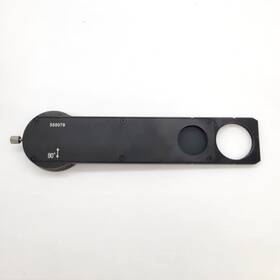
( Brand: Leica ), ( Manufacturer Part Number: 11555079 ), ( Part Type: Analyzer ), ( Country Of Origin: Germany )
Review LEICA Microscope 180 Rotating Analyzer Polarizer Slider 555079
The Leica 11555079 microscope 180 rotating analyzer polarizer slider is a precision-engineered accessory designed to enhance the functionality and versatility of polarizing microscopy, making it an indispensable tool for researchers, materials scientists, and medical professionals. This high-quality component is specifically crafted to integrate seamlessly with Leica s advanced microscope systems, offering unparalleled control over polarized light analysis. The rotating analyzer, with its smooth 180 rotation mechanism, allows users to fine-tune the orientation of the polarizer with exceptional precision, enabling detailed examination of birefringent materials, crystal structures, and anisotropic properties. Constructed from durable, optically transparent materials, the slider ensures minimal light distortion while maintaining optimal clarity and contrast, crucial for accurate observations in fields such as mineralogy, petrography, and biological tissue analysis. Its ergonomic design facilitates effortless adjustment, reducing user fatigue during prolonged sessions, while the robust build guarantees long-term reliability in demanding laboratory environments. Whether used for routine diagnostic work, advanced materials research, or educational demonstrations, this polarizer slider elevates the capabilities of polarizing microscopy, providing researchers with the tools needed to uncover subtle optical phenomena with clarity and precision.
### **Pros and Cons of the Leica 11555079 Microscope with Rotating Analyzer Polarizer Slider (Model 555079)**
#### **Pros**
1. **High-Quality Optical Performance**
The Leica brand is synonymous with precision optics, and this microscope is designed for high-resolution imaging, making it ideal for applications in biology, geology, and materials science. The rotating analyzer polarizer slider enhances contrast and detail in polarized light microscopy, which is essential for examining birefringent samples (e.g., minerals, fibers, and biological structures like muscle tissue).
2. **Versatility in Polarized Light Imaging**
The inclusion of a rotating analyzer polarizer slider (part 555079) allows for dynamic adjustments to polarization angles, improving the ability to study anisotropic materials. This feature is particularly valuable for researchers and professionals who frequently work with samples that exhibit double refraction or stress-induced birefringence.
3. **Durability and Build Quality**
Leica microscopes are known for their robust construction, ensuring long-term reliability in laboratory settings. The mechanical components, including the rotating stage and polarizer slider, are likely to be well-engineered for frequent use without excessive wear.
4. **Compatibility with Leica Ecosystem**
If you already own or plan to use other Leica microscopes or accessories, this model integrates seamlessly with Leica s existing parts and software. This can simplify maintenance, upgrades, and troubleshooting over time.
5. **Precision Engineering**
The rotating analyzer mechanism is likely to offer smooth, precise adjustments, which is critical for accurate measurements and observations in scientific research. This is particularly important in fields like crystallography or materials testing.
6. **Professional-Grade Features**
The inclusion of a polarizer slider suggests that this microscope is designed for advanced applications, making it suitable for academic research, industrial quality control, or specialized medical diagnostics.
---
#### **Cons**
1. **High Initial Cost**
Leica microscopes are premium products, and this model will likely come with a significant upfront investment compared to mid-range or consumer-grade alternatives. The cost may be prohibitive for small labs, students, or hobbyists on a tight budget.
2. **Maintenance and Repair Expenses**
Due to Leica s proprietary components and specialized service requirements, repairs or maintenance can be costly. Parts may not be readily available from third-party suppliers, and authorized service centers may charge premium rates for servicing.
3. **Complexity for Beginners**
The advanced features, such as the rotating polarizer slider, may require a learning curve for users who are not familiar with polarized light microscopy. Operators must understand how to properly align and adjust the polarizer and analyzer to avoid misinterpretation of results.
4. **Limited Customization**
Unlike some modular microscope systems, Leica s designs are often fixed in their core configurations. While the rotating analyzer slider adds flexibility, users may find it difficult to upgrade or modify other aspects of the microscope without purchasing additional Leica-compatible parts.
5. **Weight and Space Requirements**
High-end microscopes like this one are typically heavier and bulkier than consumer models. This may require dedicated space in a lab and could pose challenges for users with limited bench or storage capacity.
6. **Software and Digital Integration Dependencies**
If you require digital imaging or advanced analysis tools, you may need to invest in additional Leica software (e.g., LAS X) or compatible third-party solutions. This can add to the overall cost and complexity of use.
---
### **Conclusion**
The **Leica 11555079 microscope with the rotating analyzer polarizer slider (555079)** is an excellent choice for professionals, researchers, or advanced users who require high-performance polarized light microscopy. Its superior optical quality, precision engineering, and compatibility with Leica s ecosystem make it a reliable tool for specialized applications in biology, geology, materials science, and medical diagnostics. However, the high cost, maintenance requirements, and complexity may not justify the investment for casual users, students, or those working in fields where polarized light is not a primary requirement.
### **Recommendation**
**Purchase this microscope if:**- You work in a field that demands high-resolution polarized light imaging (e.g., mineralogy, crystallography, or advanced biological research).
- You already have or plan to integrate it with other Leica equipment.
- Budget constraints are not a limiting factor, and you can justify the long-term value of Leica s durability and performance.
- You have access to training or support to fully utilize its advanced features.
**Consider alternatives if:**- You are a student, hobbyist, or operate on a tight budget, as lower-cost brands (e.g., Nikon, Olympus, or AmScope) may offer comparable polarized light capabilities at a fraction of the price.
- You require extensive customization or modular upgrades, as Leica s closed ecosystem may be restrictive.
- Your primary use does not heavily rely on polarized light microscopy, in which case a simpler, more affordable microscope may suffice.
For most professional or research-oriented users, the **Leica 11555079 with the rotating analyzer slider is a worthwhile investment** due to its unmatched optical performance and reliability. However, weigh the cost against your specific needs to ensure it aligns with your long-term goals.
Details:
Leica Microscope Rotating Analyzer Polarizer Slider, Item is in good condition and working properly.
part #: 11555079 price
- $695.00
specifications microscopepartzo:
- brand: Leica
- mpn: 11555079
- part type: Analyzer
- country of origin: Germany
offer microscopepartzo:
- started: February 9, 2026
- sold: 0
- availability: In Stock
- options: Ship-to-home
- quantity: 1
general microscopepartzo:
- condition: Used
- Medical/Lab Equipment Attachments Accessories > Microscope Parts Accessories > Other Microscope Parts Accessories
shipping microscopepartzo:
- service: UPS Ground
- transit: 3-9 Days
- carrier: UPS
- class: Standard
- cost: $15.00
- type: Fixed
seller microscopepartzo:
- rating: 100.0%
- # reviews: 2876
- city: Sanford, North Carolina
returns microscopepartzo:
- policy: No Returns
payments microscopepartzo:
- other
- credit card: Mastercard
- wallet: Paypal
Leica 11555079 Is Similar To:
- Microscope Plan Long-barrel 1x Achromat 0.025 Iris Infinity Leica Objective (26% similar) Make sure your microscope will truly accommodates very long lens that measures 55MM vertically. 706, conforming to the RMS standard, with aperture iris, and is infinity corrected. The objective has a mounting thread 20. Leica 1x plan achromatic iris infinity long barrel microscope objective Leica 1x...(January 25th, 2015)
- Leica Microscope Tube Photo 0.66x mount 2 35mm Trinocular Efocus Adapter Port (43% similar) This adapter is suited for 1/2 and 1/3 image sensor chips microscope picture using is capture. 66X Leica ex focus microscope camera port para focal adapter to 35MM photo tube c mount. The head attached to a modified microscope base. The device is designed to insert to any microscope which contains a...(January 26th, 2015)
- 4x Parts 0.67x Head Leica Block Microscope Gz6 Focus Repair (36.4% similar) ...(February 12th, 2015)
- 0.502.29553 Leica New Microscope Pressure Plate (40.7% similar) O microscope pressure plate b: RP inventory location: MF3 6-2 this offer is for a new Leica. A non-paying bidder case will automatically be initiated after this time. Please prior to sale for an accurate shipping quote. A credit card purchase is only shipped when the money transferred from ...(November 20th, 2018)
- 020-507.010 Leitz Leica Biomed Microscope Includes Objectives (34.8% similar) Leica LTZ boomed. 90 condenser eff LTZ OBJECTIVE4. 17 eff LTZ OBJECTIVE10 microscope wit Periclean 10X 18 eyepiece objective includes everything you see in the listing. 17 eff LTZ OBJECTIVE40 oil microscope pair of 10X 18 Periclean eyepieces stage with A0. You are buying on a working great condition...(April 2nd, 2018)
- 020-654.092-000 Leica Microsystems Microscope Beamsplitter (37.2% similar) Leica micro systems microscope misapplied...(July 18th, 2017)
- 090-132.103 Leica Dm Irb Microscope Frame Sold For Parts As Is (40.6% similar) This is my: a Leica Dem orb microscope frame sold for parts as. Pin to plug into the power supply are bent and receptacle is missing gone. Cases count against me even if they are resolved. Didn't try to power this up. Sold as is for parts. I am not overjoyed with whats happening, but have to roll it...(April 8th, 2018)
- 373450 Camera Heerbrugg Wild Leica Microscope 093-032.010 Film Leitz (36% similar) 010 film back cosmetic 8 as pictured. You are purchasing exactly what you see in the pictures. Glass optic clean glass with some minor cleaning marks. Mechanical problem none offer includes LTZ microscope camera...(February 9th, 2015)
- Adapter 0.5x Leica 1.0xlens Leitz Microscope 3 2 Camera Iso38 Olympus Nikon M4 (37.6% similar) Assembly pieces minus. The adapter uses a standard ISO 38MM x c mount LTZ Leica wild ISO 38. The device is designed to insert into any microscope which contains a 38MM photo port bottom lower portion of picture. 0x port adapter see picture below for separate parts. 0x with f mount. 54 5, 31, 6, 49 ...(February 13th, 2015)
- 10246634 Leica Wild 246634 Coaxial Microscope Illuminator (35.9% similar) 25X when installed. I will describe the item best as can based on visual inspection and my knowledge of. This unit is in excellent cosmetic and working condition has been tested on my microscope. The wild coaxial Illuminati has a magnification factor of a lamp is included. Cosmetics are clean and ...(February 26th, 2018)
- 10382162 Leica Microscope Objective Lens (39.6% similar) Priced for fast sale. 50 for continental USA. You are buying on a Leica microscope objective lens f 200MMPART 10382162THE is in new condition. Shipping and handling 18...(April 6th, 2018)
