ZEISS 453664 Analyzer Slider Motorized Axiotron
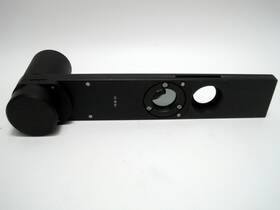
( Brand: Zeiss ), ( Manufacturer Part Number: 453664 ), ( Model: ZEISS 453664 ), ( Part Type: Analyzer )
Review ZEISS Analyzer Slider Motorized Axiotron
The **Zeiss 453664 Analyzer Slider Motorized for AxioVision** is a precision-engineered optical accessory designed to enhance the functionality and efficiency of Zeiss microscope systems, particularly those integrated with the AxioVision imaging suite. This high-performance motorized analyzer slider is engineered to provide seamless, automated control over the insertion and removal of polarizing or compensating elements within the optical path of a microscope, eliminating the need for manual adjustments during critical imaging tasks. Built with the same rigorous standards that define Zeiss optical instrumentation, this component features a robust, corrosion-resistant construction, ensuring durability in both laboratory and clinical environments. The motorized mechanism operates with smooth, silent precision, allowing users to effortlessly adjust the analyzer position with a single command via the AxioVision software interface, thereby streamlining workflows and reducing operator fatigue. Ideal for applications in materials science, mineralogy, and biomedical research, this slider is compatible with a wide range of Zeiss microscope models, including those equipped with the Axio Imager, Axio Observer, and Axio Scope series. Its integration with AxioVision software enables full automation of imaging protocols, including the precise timing and sequencing of analyzer movements, which is invaluable for time-lapse studies, quantitative analysis, and high-throughput screening. The design incorporates a low-profile, ergonomic housing that minimizes interference with the microscope s optical path while maximizing accessibility for maintenance and calibration. Additionally, the slider s modular construction allows for easy replacement or upgrade of components, ensuring long-term compatibility with evolving imaging technologies. Whether used for routine diagnostic work or advanced research, the Zeiss 453664 Analyzer Slider Motorized for AxioVision represents a sophisticated solution for laboratories seeking to optimize their microscopy workflows with reliability, precision, and ease of use.
### Pros and Cons of buying a Zeiss 453664 Analyzer Slider (Motorized for Axiotron)
#### **Pros:**1. **Precision and Accuracy** The motorized analyzer slider is designed to provide smooth, controlled movement, which is critical for microscopy applications. This reduces manual errors and ensures consistent results, especially in tasks like polarization analysis or sample alignment.
2. **Compatibility with Axiotron Systems** This specific model is engineered to integrate seamlessly with Zeiss Axiotron microscopes, ensuring optimal performance without compatibility issues. This is particularly valuable for labs or researchers already invested in the Zeiss ecosystem.
3. **Enhanced Efficiency** Motorized operation eliminates the need for manual adjustments, saving time during repetitive tasks such as rotating the analyzer or compensator. This is especially beneficial in high-throughput or long-duration experiments.
4. **Reduced User Fatigue** Manual sliders require constant physical adjustment, which can lead to fatigue over extended use. The motorized version automates this process, making it more ergonomic for prolonged sessions.
5. **Programmable and Automated Control** Many motorized sliders can be controlled via software, allowing for precise, repeatable adjustments. This is useful for automated imaging workflows or experiments requiring specific angular positions.
6. **Durability and Build Quality** Zeiss products are known for their robust construction, ensuring longevity and reliability in demanding laboratory environments.
7. **Compatibility with Advanced Imaging Techniques** The motorized slider can be paired with other Zeiss accessories (e.g., cameras, filters, or stage controllers) to create a fully automated imaging setup, enhancing capabilities for research or diagnostic work.
---
#### **Cons:**1. **Higher Upfront Cost** Motorized components are significantly more expensive than manual alternatives. The cost may be prohibitive for small labs, students, or researchers on tight budgets.
2. **Maintenance and Calibration Requirements** Motorized systems require periodic maintenance, including lubrication, software updates, and potential recalibration to ensure accuracy. This adds to the long-term operational cost and may require technical expertise.
3. **Complexity in Setup and Operation** Unlike manual sliders, motorized versions may require training to operate effectively, especially if integrating with software or automation systems. This could introduce a learning curve for users unfamiliar with motorized controls.
4. **Potential for Mechanical Issues** Motors and electronic components can fail over time, leading to downtime if repairs are needed. This risk is higher than with a simple mechanical slider.
5. **Power Dependency** Motorized sliders require a power source (e.g., USB or external power supply), which may not always be available or reliable in certain lab settings. This could disrupt workflows if the power fails.
6. **Limited Portability** Due to its motorized and potentially wired components, this slider may not be as easily transportable as a manual version. This could be a drawback for fieldwork or mobile applications.
7. **Software or Firmware Limitations** Some motorized sliders may have proprietary software or firmware that could become outdated or incompatible with newer systems. This might require additional investment in updates or replacements over time.
---
### **Conclusion:**The Zeiss 453664 analyzer slider (motorized for Axiotron) is a high-quality, precision tool that significantly enhances the efficiency, accuracy, and automation capabilities of microscopy workflows. It is particularly well-suited for professional research labs, clinical diagnostics, or applications requiring repetitive or highly precise adjustments. However, its advantages come at a higher cost, increased maintenance needs, and a steeper learning curve compared to manual alternatives.
For users who prioritize **speed, precision, and automation** and have the budget and technical support to maintain such equipment, this slider is an excellent investment. Conversely, **small labs, students, or budget-conscious users** may find a manual slider more practical, given the lower cost and simplicity.
### **Recommendation:** - **Buy the Zeiss 453664 if:**- You work in a professional lab with a Zeiss Axiotron system and require motorized precision for routine tasks.
- Your workflow involves automation, high-throughput imaging, or repetitive adjustments where manual operation would be inefficient.
- You have access to technical support for maintenance and troubleshooting.
- Budget constraints are not a limiting factor, and the long-term benefits justify the upfront cost.
- **Consider a manual alternative if:**- Your budget is limited, and you can achieve adequate results with a simpler, lower-cost slider.
- You are a student or in a non-research setting where motorized features are not essential.
- You lack the technical resources to maintain or troubleshoot motorized components.
- Portability or simplicity is a higher priority than automation.
For most **serious microscopy applications**, the Zeiss 453664 is a worthwhile upgrade. However, weigh the pros and cons carefully against your specific needs before making a purchase.
Details:
Zeiss 453664 Analyzer Slider Motorized for Axiotron. Great used condition.
part #: 453664 price
- $1649.00
specifications microscopepartzo:
- brand: Zeiss
- mpn: 453664
- model: Zeiss 453664
- part type: Analyzer
general microscopepartzo:
- Medical/Lab Equipment Attachments Accessories > Microscope Parts Accessories > Other Microscope Parts Accessories
- condition: Used
shipping microscopepartzo:
- class: Standard, Expedited
- type: Calculated
- carrier: USPS, UPS
- cost: $15.62
- transit: 4-11 Days
- service: USPS Ground Advantage, USPS Priority Mail, UPS Ground
seller microscopepartzo:
- rating: 99.3%
- city: Albany, Oregon
- # reviews: 682
offer microscopepartzo:
- availability: In Stock
- options: Ship-to-home
- sold: 0
- quantity: 1
- started: February 10, 2026
- best offers: True
payments microscopepartzo:
- credit card: Mastercard
- other
- wallet: Apple-pay
returns microscopepartzo:
- policy: No Returns
Zeiss 453664 Is Similar To:
- 000000-1170-901 Zeiss Microscope Dic Slider Ec Epn And Hr Objective (32.2% similar) 90 hr with plastic cover to protect slider. Unconditional money back guarantee item code: A338 Zeiss microscope Dick slider for EC Pen 50X. Condition: new. Zeiss microscope Dick slider for EC Pen 50X 100X. 90 hr objectives: Zeiss Dick slider item number: 901 compatible with these prisms: EC Pen 50X...(June 8th, 2018)
- 000000-1170-902 Zeiss Microscope Dic Slider Ec Epn (33.7% similar) Unconditional money back guarantee item code: A335 Zeiss microscope Dick slider EC Pen 100X condition: new. Zeiss microscope Dick slider for EC Pen 100X: item number: 902 compatible with these objectives prisms: and HX LED 50X fluorescence microscopes the solution to your microscopy needs. 80 HX LED...(June 15th, 2018)
- 000000-1201-466 Zeiss New Pinhole Adator For Axiovert (42.3% similar) The unit is still factory sealed. Shipping information sunning ships with ups and the postal service USPS. Parts removal: the items shown above will not be dismantled or separated. Available for purchase is a new Zeiss pinhole 0,5 adaptor Exocet 200 that in good physical condition and working...(May 30th, 2018)
- 05-9902 Microscope Slider Axiomat 47 Zeiss Magazine Dic Phase 57 Adjustable (27% similar) USPS or ups ground. Save packaging for carrier claim. Standard shipping prices are only good for the lower 48 states. An image to Zeiss axiom at adjustable microscope magazine Dick phase slider P/N this unit appears to be fully functional knobs spin freely lens is in good condition scratches are ...(February 3rd, 2015)
- Slider Polarizer 47 57 Axiomat Analyzer 10-9902 Zeiss Aperture Diaphragm Iris (29.7% similar) All parts, accessories, cables, etc. Your satisfaction is extremely important to us. Cash is only accepted for will calls. All pictures are taken in house. Minimum handling charge is 75 onto a standard pallet and increases for custom pallet's. Please review images thoroughly before purchasing. If in...(January 23rd, 2015)
- 1005-868 Zeiss Docking Station For (35.3% similar) Photos accurately show the condition of item. Equipment is tested to power up and basic functions only. Zeiss docking station for axio observer, imagery new: new, see pictures condition. Some equipment is available with warranty, training and installation. We combine shipping charges when possible...(August 2nd, 2017)
- Slider Iii Neofluar 1033-912 Zeiss 40x 1.30 Prism Plan Nomarski Dic Microscope (24.8% similar) Mechanically and optically in excellent condition. For use with transmitted light Dick with Zeiss axio series microscopes. 14 day money back guarantee if you're not satisfied for any reason...(February 27th, 2015)
- 1050-958 Carl Zeiss Analyzer Module (41.9% similar) This listing is for the following item: 1 analyzer module c Carl Zeiss part condition like new as mentioned in title, no signs of scratches, scuffs, external damages or any internal optical defects. Please see photos for further details of condition...(April 30th, 2017)
- 1106-041 Zeiss Scan Module For Lsm Pascal Vario Two Good (35.5% similar) See our photos for best information of item and package condition...(December 26th, 2018)
- 2668-2 Si10 Cz Carl Zeiss Rotatable Degree Microscope Stage For Jenalumar (24.2% similar) Carl Zeiss rota table 180 degrees microscope stage for Ngaliema testing cosmetic notes: fully functional unit. This does not represent a guarantee or warranty about the items functionality beyond what is depicted in photos. Any order placed after 9:00. If you happen to have an issue with item. ...(November 8th, 2018)
- 302581-9247-000 Zeiss Microscope Pentero Infrared Target For Surgical (33.3% similar) Zeiss microscope Pinter infrared 800 target for surgical new in box...(April 13th, 2018)
