ZEISS C201313 Chroma Et Fish Filter Set Cube 49303 ET-GRNE1
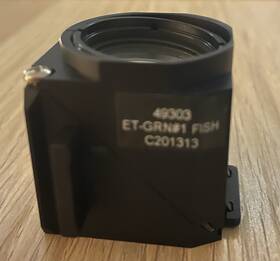
( Brand: Zeiss ), ( Manufacturer Part Number: C201313 ), ( Part Type: Filter )
Review ZEISS Chroma Et Green#1 Fish Filter Set Cube
The **Zeiss C201313 Chroma 49303 ET Fish Filter Set Cube (ET-GRNE1)** is a high-performance, precision-engineered optical filter cube designed specifically for advanced fluorescence microscopy applications, particularly in biological and biomedical research. This meticulously crafted filter set is tailored to optimize the excitation, emission, and dichroic separation of light for imaging fluorescent dyes and proteins, ensuring maximum sensitivity, contrast, and spectral purity in live-cell and fixed-sample imaging. The cube is built around Chroma s renowned **ET-GRNE1** filter configuration, which combines a **493/22 nm excitation filter**, a **506LP dichroic mirror**, and a **535/30 nm emission filter**, creating an ideal spectral window for imaging green fluorescent proteins (GFPs), fluorescein, and other fluorophores with peak excitation around 490 500 nm. The **ET (Edge-Tuned)** designation signifies that these filters have been optimized for minimal spectral overlap and maximum transmission efficiency, reducing autofluorescence and phototoxicity while enhancing signal-to-noise ratios in complex biological samples.
Constructed with **Zeiss s rigorous optical standards**, this filter cube features ultra-thin, high-precision glass substrates and proprietary **Chroma s high-performance dichroic mirrors**, which are engineered to minimize stray light and maximize light throughput. The **493/22 nm excitation filter** is designed to isolate a narrow bandwidth of blue-green light, precisely matching the absorption peak of GFP and related fluorophores, while the **506LP dichroic mirror** efficiently reflects shorter wavelengths (excitation light) toward the sample while transmitting longer emission wavelengths (506 nm and above) to the detector. The **535/30 nm emission filter** then further refines the collected light, capturing the characteristic green fluorescence while blocking residual excitation light and out-of-band autofluorescence, ensuring crisp, high-contrast images even in multi-channel experiments.
Ideal for applications such as **live-cell imaging, calcium imaging (with indicators like Fura-2 or GCaMP), protein trafficking studies, and neuronal activity monitoring**, this filter set excels in systems requiring both **high sensitivity and spectral selectivity**. Its compact, cube-mounted design integrates seamlessly into Zeiss s advanced fluorescence microscopes, including the **Axio Observer, Axio Imager, or LSM series**, while its robust construction ensures durability and long-term stability under high-intensity illumination. Researchers working with **GFP-tagged proteins, FITC-labeled antibodies, or other green-emitting fluorophores** will benefit from the cube s ability to minimize bleed-through and maximize signal integrity, making it an indispensable tool for both routine and cutting-edge fluorescence microscopy. Whether used in single-channel imaging or in combination with other filter cubes for multi-color experiments, the **Zeiss C201313 Chroma 49303 ET Fish Filter Set Cube** delivers uncompromising optical performance, enabling researchers to visualize biological processes with unprecedented clarity and precision.
The **Zeiss C-201313 Chroma 49303 ET Fish Filter Set Cube (ET-GRNE1)** is a specialized filter cube designed for fluorescence microscopy, particularly for imaging certain fluorescent proteins or dyes in biological samples. Below is a detailed breakdown of its pros and cons, followed by a conclusion and recommendation.
---
### **Pros of the Zeiss C-201313 Chroma 49303 ET Fish Filter Set Cube**
1. **High-Quality Optics and Filters**
The Chroma filters used in this cube are known for their precision and durability. Chroma is a leading manufacturer of optical filters, and their ET (Edgepass) filters are designed to minimize autofluorescence and maximize signal-to-noise ratios. This ensures clearer, more accurate imaging of fluorescent markers.
2. **Compatibility with Zeiss Microscopes**
This cube is specifically designed for Zeiss microscopes, ensuring seamless integration with the optical path and software. It is engineered to work efficiently with Zeiss s fluorescence systems, reducing potential compatibility issues that might arise with third-party cubes.
3. **Optimized for Specific Fluorescent Proteins**
The ET-GRNE1 cube is tailored for imaging green fluorescent proteins (GFPs) and related fluorophores, such as enhanced GFP (eGFP), GFP variants, and some fluorescent dyes that emit in the green spectrum. This makes it ideal for applications like calcium imaging, protein tracking, or live-cell imaging where GFP is commonly used.
4. **Durability and Longevity**
Zeiss and Chroma filters are built to withstand repeated use without significant degradation. The cube s construction is robust, reducing the risk of misalignment or damage over time, which is critical for long-term research or clinical use.
5. **Minimized Crosstalk and Bleed-Through**
The design of the cube, including the use of high-quality dichroic mirrors and emission filters, helps reduce crosstalk between excitation and emission wavelengths. This is particularly important in multi-color imaging experiments where multiple fluorophores are used simultaneously.
6. **Backward and Forward Compatibility**
The cube is designed to fit standard filter cube holders on Zeiss microscopes, making it easy to swap in and out without extensive modifications. This flexibility is useful for researchers who need to switch between different filter cubes for various experiments.
7. **Support for Advanced Imaging Techniques**
The cube can be used in conjunction with other Zeiss accessories, such as cameras, light sources, and software tools, to support advanced imaging techniques like confocal microscopy, TIRF (Total Internal Reflection Fluorescence), or FRAP (Fluorescence Recovery After Photobleaching).
---
### **Cons of the Zeiss C-201313 Chroma 49303 ET Fish Filter Set Cube**
1. **Limited to Specific Fluorescent Proteins**
The cube is optimized for green fluorescent proteins and related dyes. If your research involves other fluorophores (e.g., red, blue, or far-red), you would need additional cubes, which can increase costs and complexity. This limitation may not be ideal for multi-color experiments without additional investment.
2. **Cost**
Zeiss and Chroma filter cubes are generally more expensive than generic or third-party alternatives. The price point may be prohibitive for small labs, students, or researchers on tight budgets. The cost must be justified by the need for high-quality, Zeiss-compatible imaging.
3. **Potential for Autofluorescence**
While the cube is designed to minimize autofluorescence, some biological samples or environmental factors (e.g., background fluorescence from the sample or microscope components) can still interfere with imaging. This may require additional optimization or the use of supplementary filters.
4. **Maintenance and Calibration**
Over time, filters and dichroic mirrors can degrade due to exposure to intense light sources or UV radiation. While the cube is durable, periodic calibration or replacement of components may be necessary to maintain optimal performance. This adds to the long-term cost of ownership.
5. **Dependence on Zeiss Infrastructure**
The cube is tailored for Zeiss systems, which means it may not be compatible with non-Zeiss microscopes without adapters or modifications. Researchers using other microscope brands may face additional costs or limitations in integrating this cube into their setup.
6. **Learning Curve for New Users**
If the user is unfamiliar with fluorescence microscopy or Zeiss systems, there may be a learning curve associated with properly setting up and optimizing the cube for their specific application. This could lead to initial inefficiencies or suboptimal imaging results.
7. **Size and Physical Constraints**
Filter cubes occupy space in the microscope s optical path, and their size may limit the flexibility of the microscope setup. In some cases, the physical dimensions of the cube might require adjustments to the microscope s configuration, which could be inconvenient for certain applications.
---
### **Conclusion**
The **Zeiss C-201313 Chroma 49303 ET Fish Filter Set Cube (ET-GRNE1)** is a high-quality, specialized tool for fluorescence microscopy that excels in imaging green fluorescent proteins and related dyes. Its strengths lie in its precision, compatibility with Zeiss systems, and durability, making it a reliable choice for researchers focused on GFP-based experiments. However, its limitations such as the narrow range of compatible fluorophores, high cost, and dependence on Zeiss infrastructure may not make it suitable for all applications or budgets.
This cube is particularly well-suited for:- Researchers working exclusively or primarily with GFP or GFP variants.
- Labs already invested in Zeiss microscopy systems.
- Applications requiring high-resolution, low-autofluorescence imaging of green fluorophores.
For users who require imaging of multiple colors or are working with non-Zeiss equipment, alternative filter cubes or third-party options may be more cost-effective or versatile.
---
### **Recommendation**
If your research involves **green fluorescent proteins (GFP, eGFP, etc.) and you are using a Zeiss microscope**, the **Zeiss C-201313 Chroma 49303 ET Fish Filter Set Cube** is a strong choice due to its reliability and integration with Zeiss systems. Invest in this cube if:
- You prioritize high-quality, low-autofluorescence imaging.
- Your budget allows for the premium cost of Zeiss and Chroma components.
- You do not require imaging of other fluorophores simultaneously.
If, however, you:- Need to image multiple colors (e.g., GFP, RFP, CFP) and cannot justify purchasing multiple cubes, consider a **multi-bandpass cube** or a **tunable filter system** that can cover a broader range of wavelengths.
- Are working with non-Zeiss microscopes, explore **third-party filter cubes** (e.g., from Chroma, Semrock, or Olympus) that may offer similar performance at a lower cost.
- Have a limited budget, evaluate whether a used or refurbished cube from a reputable source could provide comparable performance at a reduced price.
Ultimately, weigh the specific needs of your research against the cube s capabilities and cost to determine whether it is the right investment for your workflow.
Details:
Filter is in excellent condition. The Chroma 49303 ET - Green#1 FISH filter set from Technology is designed for use with commercially available probes and chromosome painting techniques.
part #: c201313 price
- $300.00
specifications microscopepartzo:
- brand: Zeiss
- mpn: C201313
- part type: Filter
shipping microscopepartzo:
- service: USPS Ground Advantage
- type: Calculated
- cost: $6.07
- carrier: USPS
- transit: 7-11 Days
- class: Standard
offer microscopepartzo:
- availability: In Stock
- options: Ship-to-home
- sold: 0
- started: May 22, 2026
- quantity: 1
returns microscopepartzo:
- policy: No Returns
payments microscopepartzo:
- other
- wallet: Google-pay
- credit card: Visa
general microscopepartzo:
- Medical/Lab Equipment Attachments Accessories > Microscope Parts Accessories > Other Microscope Parts Accessories
- condition: Used
seller microscopepartzo:
- # reviews: 26
- city: Stratford, Connecticut
- rating: 90.6%
Zeiss C201313 Is Similar To:
- 000000-1374-896 Carl Zeiss Vg Green Filter Microscope (36.1% similar) New with no signs of normal wear and tear. Carl Zeiss VG 9 green FILTER32X2MM item number: 896 filter, 32X2MM for contrast enhancement phase and b w image recording unused - with box excellent condition. This item is unused and untested...(March 31st, 2018)
- Case Storage 000000-1766-630 Cube Reflector Carl Zeiss (22.8% similar) Carl Zeiss reflector cube storage case Carl Zeiss reflector cube storage case condition good condition...(January 6th, 2015)
- 1046-274 Carl Zeiss Reflector Module Axio Cube (29.6% similar) Zeiss reflector modules cube, excellent condition...(March 26th, 2018)
- 2-fl Zeiss Microscope Fluorescence Filter Cube (41.7% similar) In great condition...(December 16th, 2018)
- 304752 427.00 Carl Zeiss Jena Microscope Fluorescence Filter Nos (28.6% similar) Zeiss Jean microscope fluorescence filter 20MM B427 BG18: 427. Nos new old stock - from a lot of verb Carl Zeiss Jean filters...(February 17th, 2019)
- 424931 Zeiss Filter Cube Sets (38.8% similar) I have no idea what it is. Please feel free to ask me any questions, and good luck. All are used but look in really nice condition. Shipping is free to the lower 48 states outside of that, we'll talk. They are all mounted in a cube: 1 filter set 49 G365 ft 395 BP filter 38HE FT495 20 560 unmarked. ...(September 26th, 2017)
- 428320-9001 Zeiss Filter Wheel (30.3% similar) Zeiss microscope motorized filter wheel...(February 26th, 2019)
- 433904-8031-000 Carl Zeiss Farbfilter Set (29.1% similar) A2AXIO imagery. Z1 Potomac's imagery. Listing includes: Zeiss 10 degree eyepiece slider - 000ZEISS 80 camera fabled 000ZEISS compatible with:axiom imagery. Z2MAXIO scope. D2AXIO imagery. Z2AXIO imagery. M2MAXIO imagery. D1MAXIO imagery. D1AXIO imagery. M1AXIO imagery. A1MAXIO imagery. Carl Zeiss ...(May 10th, 2017)
- 447230 Carl Zeiss Filter Wheel (30.3% similar) Mounted to a Zeiss beam splutter part that splits the incoming light two sources. Unconditional money back guarantee item code: A314 filter wheel on stand with Zeiss beam splutter for microscope: fluorescence excitation. Fluorescence microscopes the solution to your microscopy needs. Made for a ...(November 27th, 2017)
- 45-28-71 Zeiss Microscope Fl Fluorescence Filter Cube Slider Housing (38% similar) Sold as shown with nothing else included. Zeiss microscope fl fluorescence filter cube slider housing...(December 22nd, 2018)
- 451366 Zeiss Axioline Fl Fluorescence Cube Slider Part (35.8% similar) If it is not pictured assume included. Exactly what is pictured included. Zeiss microscope 3FL fluorescence filter cube slider housing hello, you are viewing a listing of product wood man mechanical surplus. They are expected to show some wear as pre-owned...(September 20th, 2018)
